A fascinating event is taking place next week on 4th June at the University of Edinburgh: a one day workshop titled “Shadow Agents of War”, which will focus on the role in war of certain players who are largely overlooked by scholars of war and conflict, such as refugees, convicts, commoners and even animals. The workshop also promises to tackle methodological issues and point to relevant sources. The workshop is co-organised by Stephen Bowd, who is currently working on a project on gender and early modern warfare, Sarah Cockram, who focuses on the early modern period, too, and is interested in historical animal studies, and John Gagné whose current book project is on transcultural war in the early sixteenth century.
The workshop will have three sessions: The Unwilling Agents of War; The Organisers of War; The Suppliers of War.
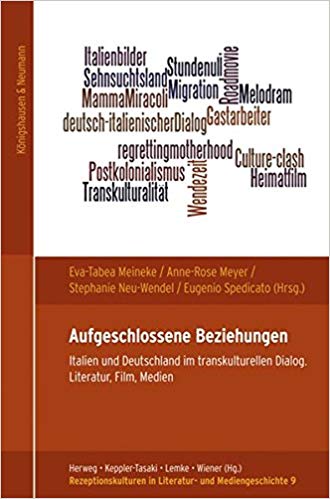
Das Bild des italienischen Soldaten im deutschsprachigen Diskurs über die Vergangenheitsverwaltung, in Aufgeschlossene Beziehungen. Deutschland und Italien im transkulturellen Dialog. Literatur, Film, Medien, ed. by Tabea Meineke, Anne-Rose Meyer-Eisenhut, Stephanie Neu-Wendel and Eugenio Spedicato, Würzburg, Verlag Königshausen & Neumann, 2019, 67-80
Among the contributions appeared in the book Aufgeschlossene Beziehungen (Open-minded Relationships), devoted to the exploration of the way in which the Italian and German cultures have built their transcultural dialogue since WW2, one chapter by Gianluca Cinelli investigates how German post-war narratives, both literary and historical, represented the Italian soldiers in a very negative way, thus paving the way to the consolidation of an old anti-Italian prejudice spread all over Germany. The German combatants came across the Italians during WW2 as allies between 1940 and September 8, 1943, when Italy surrendered to the Allies. What emerges from this contribution is that little attention has been paid in Germany to this topic. Nonetheless, Italian soldiers were represented as lazy and unfit for war, unworthy in battle and unreliable as allies, cowardly and too soft to endure the hardship of modern warfare. And even worse, they were depicted as traitors following Italy’s withdrawal from the conflict in 1943, after which a remarkable number of Italians began to fight against the Germans as partisans.
The chapter builds on historical and literary sources, by combining the testimonies of former German cambatants (from privates of the Afrikakorp to memoirs of such Whermacht higher officers as Rommel or Kesselring) with historic evidence collected by mainly German scholars (from Hammerman to Klinkhammer and Schlemmer). The main thesis of the chapter consists in claiming that the anti-Italian prejudice largely depended on the effectiveness of Nazi propaganda and on the circulation of a number of testimonies that depicted the Italians as inferiors not only as for their military virtues but also on a racial basis. In the end, only the massive integration of Italian immigrants starting from the 1950s began to challenge the dominant stereotype and to rehabilitate the memory of the former allies-and-enemies as human beings and fellow citizens.
The Istituto Piemontese per la Storia della Resistenza e della Società Contemporanea “Giorgio Agosti” will host the 15th edition of the research seminar “Giellismo e azionismo – cantieri aperti” on the 17th and 18th of May 2019.
The complete program of the seminar can be downloaded at:
 Close Encounters in War