Book Review: “The European Art Market and the First World War. Art, Capital, and the Decline of the Collecting Class, 1910-1925” by Maddalena Alvi, Cambridge, Cambridge University Press, 2025

By Gianluca Cinelli

The relationship between art and the First World War is often looked at by focusing on how the conflict encouraged the emergence of novel and original subjects and styles, both in literature and the arts. However, the aesthetic aspects only reveal one aspect of the relationship between armed conflicts and artistic activity. Maddalena Alvi, a young scholar at the University of Manchester, approached this topic from a different perspective. Instead of considering how the conflict affected the poetics and creativity of European artists, Alvi focuses on the art market, thus shifting the axis of the investigation to the field of cultural economy. This phrase means that culture, including art and its market, is part of the economic life of societies, and as such, it played a paramount role in the war economy between 1914 and 1918. Alvi’s book, therefore, focuses on the cultural and ideological implications of trading art in Europe between 1910 and 1925.
Read the full text here

“Shared in Shards”:  Fragments from the War in Ukraine.

Review of Oksana Maksymchuk’s Still City, Diary of an Invasion

By Sarah Montin

Are they there yet?” is the question haunting Oksana Maksymchuk’s debut collection in English which chronicles the period just before and after Russia’s invasion of Ukraine in February 2022. Exiled in the US since the 1990’s, author of two poetry collections in Ukrainian and the celebrated co-translator of Apricots of Donbas by Lyuba Yakimchuk and The Voices of Babyn Yar by Marianna Kiyanovska, Oksana Maksymchuk returned to her hometown of Lviv just before Russia launched its “special operation” on 24th February 2022. Poised for war, Maksymchuk’s poetic Diary of an Invasion is frozen in the expectation of violence, hushed in the anxiogenic stillness of “things to come/waiting to be unwrapped” (When a Missile Finds a Home).

“Snow is a strange white word” wrote British war poet Isaac Rosenberg as he learned of Great Britain’s entrance in the war in August 1914 and witnessed the winter of the world closing in: “Ice and frost and snow / From earth to sky / This summer land does know / No man knows why” (On Receiving the First News of the War).

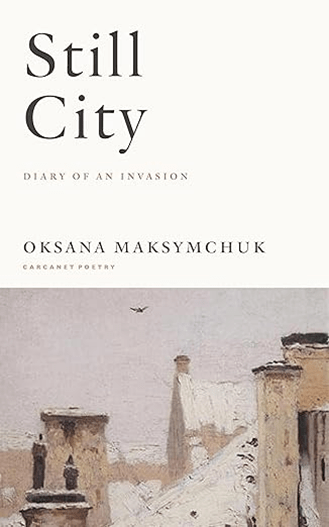
More than a hundred years later, the cover of Still City, featuring snow-laden roofs against a white sky and a drone-like bird frozen mid-air suggests in the same manner the looming Homeric “white ruin” of war under the false serenity of snow. It also materializes the force lines that shape the collection (and perhaps war poetry in general) – namely the symbolic and formal dialectic between stillness and movement, expansion and concentration, abstraction and figuration…

Continue reading the review here

Book Review: “Fascism, the War, and Structures of Feeling in Italy, 1943-1945” by Simonetta Falasca-Zamponi, Oxford, Oxford University Press, 2023

By Gianluca Cinelli

In the wake of recent studies about Italian participation in the Second World War, this volume fills a gap in historical knowledge by focusing on sources that have been neglected or at least not investigated thoroughly and systematically. These sources are diaries that Italian citizens with different social, professional and geographical backgrounds wrote between 25 July 1943 and the end of the war in the spring of 1945. The author analysed 90 diaries (out of 150 consulted) collected at the Archivio della scrittura popolare in Trento, the Archivio diaristico nazionale in Pieve Santo Stefano, and the Archivio Ligure della scrittura popolare in Genoa. The author chose to focus her investigation on diaries because “in a situation characterized by institutional uncertainties and historical unknowns, such as the one Italy faced between 1943 and 1945, feelings of incongruousness and confusion unsettled people’s usual understandings and disrupted their conventional patterns of interpretation and action” (p. 6). Therefore, the day-to-day practice of diary-writing permits her to observe the “ordinary” as it varies across generation, class, and gender and see through these “marginalised narratives” how “people’s interpretation of historical events from the standpoint of their everyday experience affected their responses to those same events and created new political sensibilities” (p. 28). To do that, the author refers to Raymond William’s analytical tool known as “structures of feeling”, a formula cast to convey the idea of the “felt sense of the quality of life” at a particular historical time (p. 4)…

Read the full text here

Book Review: “From War Archives to War Poetry”. Taking Mesopotamia by Jenny Lewis, Oxford Poets/Carcanet, 2014

By Sarah Montin

Jenny Lewis’ captivating collection of war poems, published in 2014, on the centenary of the First World War, appears even more relevant today as Europe finds itself once more engaged in armed conflict.

“My father died when I was few months old and I have been searching for him ever since announces the poet in her preface (Lewis 2014a, 11), presenting her collection as a voyage into her father’s military service in the First World War, initiated by her timely discovery of “a dusty old suitcase” full of “faded papers and memorabilia” in her basement at Oxford (Lewis 2014b). Fruit of extensive research at the National Archives and the Imperial War Museum – six years looking into her father’s service as a Second Lieutenant in the 4th Battalion of the South Wales Borderers – and supplemented by interviews of contemporary soldiers and war victims, Taking Mesopotamia offers a persuasive reflexion on the experience of war from the perspective of combatants and civilians alike. Fostering parallels between the British Mesopotamian Campaign of the Great War (1914-1918), the war in Iraq (2003-2011), and the 4000-year-old Sumerian Epic of Gilgamesh, Jenny Lewis offers a multi-layered reflection on the timeless themes of war and man’s hubris, alluded to in the book’s epigraph: “As for humans, their days are numbered/Whatever they do is like a puff of wind” (Gilgamesh, Tablet III)…

Read the full text here

Book Review: “A Veteran’s Toughest Fight. Finding Peace After Vietnam”, by David T. Klein, Jefferson, McFarland, 2024

By Gianluca Cinelli

A Yiddish proverb, as Auschwitz survivor Primo Levi recalls, says that it’s good to talk about bygone troubles. However, Yiddish culture can be profoundly ironic, and Primo Levi mastered the subtle art of understating. Troubles that one can tell belong in the past, yet they still linger on in the present as memories. Talking about bygone troubles is good because it means we saw them through. However, it does not mean that it is pleasant or easy. It takes courage and strength to face nightmarish and painful memories. Many of us remember the Ancient Mariner, who feels the compelling urge to stop people down the street and keep them listening to his guilt-ridden story full of horrors and fear. He acts like a madman, roaming the streets like an outcast, for he lives stuck in his haunting past and never finds his way back into society. The Ancient Mariner feels he must atone for his guilt of having killed the innocent albatross and survived in the place of his comrades, who died because of his hubris. Split as he is between past and present, the Ancient Mariner is no longer whole.

Talking about haunting memories is hard but necessary to lift their evil spell, as Edward Tick writes in the Foreword to this book by David T. Klein: “Warriors have their horrific ordeals and need their stories. Story is critical to warrior healing and restoration. To restore the warrior’s spirit, we must support her or him in ‘re-storying’. To disallow storytelling, as well-intentioned brief therapies do, is to betray the warrior by blocking necessary steps in their healing and homecoming” (p. 2).

Published by McFarland (McFarlandBooks.com)

Read the full text here

“The Most Urgent of Dispatches”: One Language by Anastasia Taylor-Lind, Sheffield, Smith|Doorstop Books, 2022

By Sarah Montin

In his poem “Resistance”, written in March 2022, Simon Armitage draws on the collective memory of previous wars to comment on the recent Russian invasion in Ukraine. Quoting Philip Larkin’s celebrated “MXCXIV”, the Poet Laureate inscribes his response to the conflict in Ukraine in that eternal palimpsest that is war poetry:

It’s war again: a family
carries its family out of a pranged house
under a burning thatch.
The next scene smacks
of archive newsreel: platforms and trains
(never again, never again)

Read the full text here

Book review: Deborah Rohan, “The Olive Grove. A Palestinian Story”, London & Berkeley, SAQI, 2008

The Olive Grove by Deborah Rohan is a memoir of the Palestinian people told through multiple generations of the Moghrabi family and their friends and neighbors from 1913-1948, from the Ottoman through the British occupations and up through the Zionist invasions and the birth of modern Israel.

World history and great power politics put the Palestinians and the Jews in bloody conflict and collision since the world wars. Both peoples were denied adequate refuge, help or support by powers large and small. Both peoples were largely unwanted in the countries that voiced support for one or the other. Great powers gave little succor, first controlling their territories and governments, then forcing them into collision in the Holy Land so dear to both. This conflict, with only occasional abeyance but never a secure peace, has been raging for many decades. The present war is its latest horrific iteration.

Contemporary conditions make The Olive Grove an imperative read today.

Read the review by Edward Tick here

Book review: Maria Anna Mariani, “Italian Literature in the Nuclear Age. A Poetics of the Bystander”, Oxford, Oxford University Press, 2023

During the Cold War, Italy was not allowed by the international treaties to detain its own nuclear arsenal. However, owing to its strategic geographical position amid the Mediterranean Sea, the Italian peninsula provided an ideal launch platform for NATO’s warheads and aeroplanes. Thus, the indirect involvement of Italy in the Cold War was crucial, albeit underrated and too often passed over in silence by both Italian politicians and intellectuals. Mariani’s fine volume aims to challenge such a grey zone of the Italian memory, by investigating how the discourse on Italian participation in the Cold War was addressed by some Italian authors and intellectuals of the time, namely Italo Calvino, Alberto Moravia, Elsa Morante, Pier Paolo Pasolini, and Leonardo Sciascia.

Read the review here

Book review: “Rome, 16 October 1943. History, Memory, Literature”, by Mara Josi. Cambridge, Legenda, 2023

On Saturday 16 October 1943, the largest single round-up and deportation of Jews from Italy happened. The Germans arrested 1259 people in the Roman ghetto and deported them to Auschwitz-Birkenau. Only 16 survivors, among which one woman, returned after the war.

Mara Josi investigates how 16 ottobre 1943 by Giacomo Debenedetti, La Storia by Elsa Morante, La parola ebreo by Rosetta Loy, and Portico d’Ottavia 13 by Anna Foa have handed down the legacy of the Roman round-up over eighty years.

Read the review here

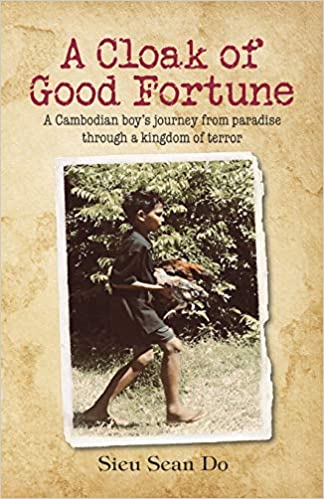
Book review: “A Cloak of Good Fortune. A Cambodian Boy’s Journey From Paradise Through a Kingdom of Terror”, by Sieu Sean Do. San Francisco, Hibiscus Press, 2019

By Edward Tick

“This is too much! It seems like I just get over one crisis and another occurs. I need to piece my soul together.” So blurted author Sieu Sean Do’s mother after the family’s harrowing and narrow escape into Viet Nam from the Khmer Rouge genocide in their native Cambodia. Sieu Sean’s memoir of the family’s journey from an idyllic childhood in rural Cambodia through the hell of the Killing Fields is his work through witnessing and storytelling to piece his soul together.

Sieu’s narrative of the family’s long ordeal is largely straightforward. He was a child and teenager during these ordeals, so we see them through the innocent boy’s eyes. The narrative piles incident upon incident as challenges, crises, betrayals, disappointments, abandonments, starvation, crimes, executions, and accidental deaths cascade not only upon this family, but all of Cambodia. Yet the story takes us to Cambodian traditions and intimately into his large extended family that, miraculously, survived together. As he summarizes at the end, “Our elders taught us well that we need to survive not just alone, but together.” Thus, as readers we have close encounters not just with the horrors of genocide, but the intimacies of a traditional Cambodian family and many traditional practices and folk tales that surround and support the survivors in their ordeals.

Read the full text here