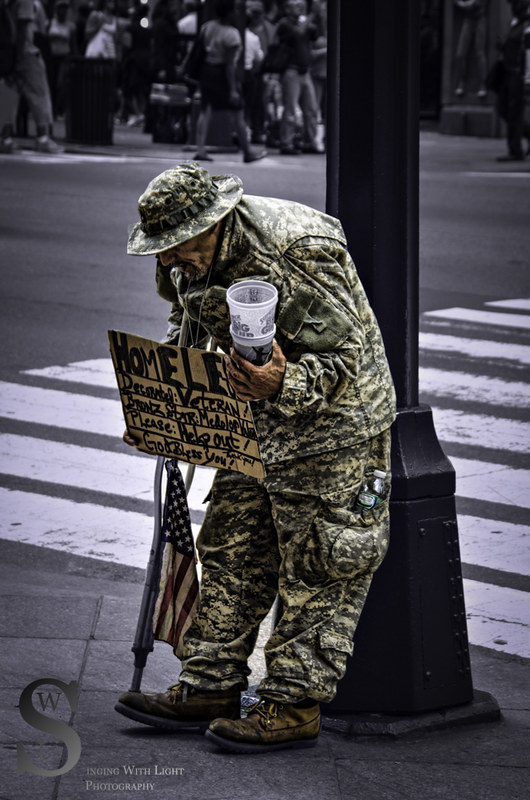
“Boots”. A short story by DC Diamondopolous

Common Creatives CC BY-NC-ND 2.0

The same sun scorched downtown Los Angeles that had seared the Iraq desert. Army Private First Class Samantha Cummings stood at attention holding a stack of boxes, her  unwashed black hair slicked back in a ponytail and knotted military style. She stared out from Roberts Shoe Store onto Broadway, transfixed by a homeless man with hair and scraggly beard the color of ripe tomatoes. She’d only seen that hair color once before, on Staff Sergeant Daniel O’Conner.

      The man pushed his life in a shopping cart crammed with rags and stuffed trash bags. He glanced at Sam through the storefront window, his bloated face layered with dirt. His eyes had the meander of drink in them.

      Sam hoped hers didn’t. Since her return from Bagdad a year ago, her craving for alcohol sneaked up on her like an insurgent. Bathing took effort. She ate to exist. Friends disappeared. Her life started to look like the crusted bottom of her shot glass.

      The morning hangover began its retreat to the back of her head.

      The homeless man vanished down Broadway. She carried the boxes to the storeroom.

      In 2012, Sam passed as an everywoman: white, black, brown, Asian. She was a coffee colored Frappuccino. Frap. That’s what the soldiers nicknamed her. Her mother conceived her while on ecstasy during the days of big hair and shoulder pads. On Sam’s eighteenth birthday, she enlisted in the Army. She wanted a job and an education. But most of all she wanted to be part of a family…
Read the short story as a PDF

“Lioness”. Flash Fiction

By Scott Rye

It wasn’t so much that Betty Lynn Campbell was pretty. She wasn’t. But there was something about her. On her best days, she bore a slight resemblance to a young Meryl Streep. Probably the Polish genes inherited from her mother. No, Betty Lynn wasn’t pretty. What she was, though, was a dude magnet. She was never going to be Homecoming Queen, but she was popular with the football players. Slut? Whore? Easy? Nobody ever used those words, exactly, when describing Betty Lynn. “Animal magnetism”, maybe. That’s what she had, they said. And it was true that she seemed to exude some sort of literal magnetism: Betty Lynn was unable to wear a watch because it would stop working within a day or two of putting it on. Doctors were at a loss to explain the phenomenon…

Read the full story here

“Burial at Sea”, by Lawrence Markworth

An old warrior, relegated to obscurity in the backwaters of San Diego Bay with the rest of the Navy’s unwanted fleet, waited. A destroyer, unable to serve her country after a crippling collision that amputated most of her bow, the USS Tingey was disabled, decommissioned, and cast aside. Guns removed from her decks, stripped of every piece of machinery of value, no longer able to fight, she lay naked, aging, and lonely, secretly wishing for rehabilitation or death. From her remaining superstructure, she could occasionally see the proud fleet leaving the bay for the real action in the South China Sea. She longed to be with them, cutting the waves at 30-plus knots, protecting aircraft carriers, looking for Russian submarines, or shelling the enemy in some far-away jungle. Instead, rust ran rampant through her decks, passageways, bulkheads and bilges, eating away at her insides like an inoperable cancer. But the worst was the neglect. No one worked on her, no one visited, no one cared. Nothing but silence, except for the occasional wave lapping at her rust-oozing sides, as a tugboat brought in another old hulk. How long could this idleness and humiliation last?

Continue reading the full text here

Close Encounters in War launches a new section for stories and poetry

Stories and poems of close encounters in war

Close encounters in war are, before anything else, life experiences that change in depth those who make them. As editors of the Close Encounters in War Journal, we have always been aware of this simple but basic fact and therefore decided to open the third issue of the journal (2020) to creative writing. We wanted to propose an experimental encounter between scholarly research and forms of creative and non-fictional writing whose roots go deep into experience and imagination.

After that exciting experience, being aware that stories and poems of close encounters in war deserve a place of their own in the website, we are happy to announce the launch of the new section “Stories and poems of close encounters in war“.

This new section of the journal is divided into three subsections (Poetry, Fiction, and Testimonies and Autobiographical Essays) and is meant to be a space for creativity and exploration of all those forms of writing that help us understand war more thoroughly as a multifaceted and complex experience. We invite storytellers, veterans, practitioners, relatives and friends of veterans, poets, therapists, and much more to feel free to submit their contributions to the CEIWJ. We will be happy and grateful to read year round your original and unpublished works about your encounters in and with war, real and imagined. We will select and publish the best, more insightful, and inspiring contributions.