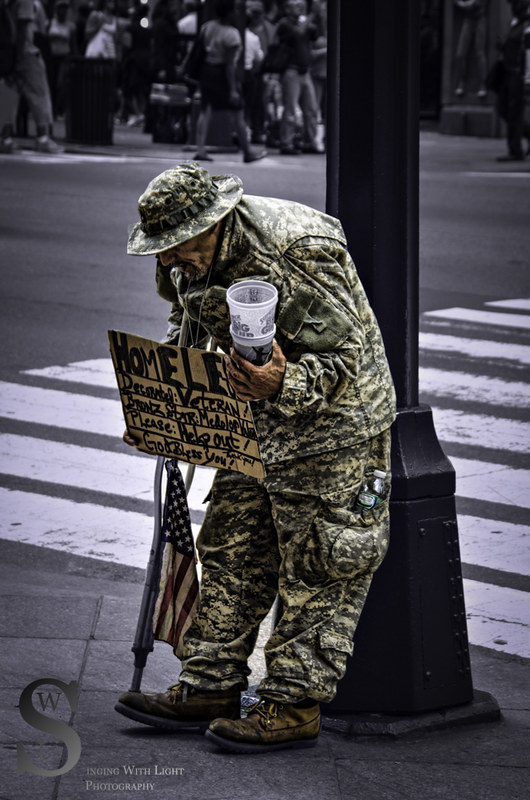
“Boots”. A short story by DC Diamondopolous

Common Creatives CC BY-NC-ND 2.0

The same sun scorched downtown Los Angeles that had seared the Iraq desert. Army Private First Class Samantha Cummings stood at attention holding a stack of boxes, her  unwashed black hair slicked back in a ponytail and knotted military style. She stared out from Roberts Shoe Store onto Broadway, transfixed by a homeless man with hair and scraggly beard the color of ripe tomatoes. She’d only seen that hair color once before, on Staff Sergeant Daniel O’Conner.

      The man pushed his life in a shopping cart crammed with rags and stuffed trash bags. He glanced at Sam through the storefront window, his bloated face layered with dirt. His eyes had the meander of drink in them.

      Sam hoped hers didn’t. Since her return from Bagdad a year ago, her craving for alcohol sneaked up on her like an insurgent. Bathing took effort. She ate to exist. Friends disappeared. Her life started to look like the crusted bottom of her shot glass.

      The morning hangover began its retreat to the back of her head.

      The homeless man vanished down Broadway. She carried the boxes to the storeroom.

      In 2012, Sam passed as an everywoman: white, black, brown, Asian. She was a coffee colored Frappuccino. Frap. That’s what the soldiers nicknamed her. Her mother conceived her while on ecstasy during the days of big hair and shoulder pads. On Sam’s eighteenth birthday, she enlisted in the Army. She wanted a job and an education. But most of all she wanted to be part of a family…

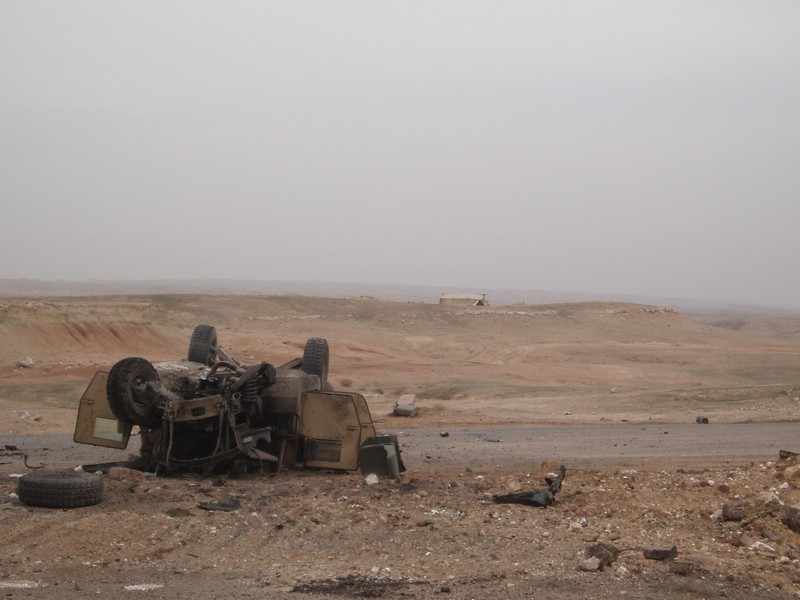
Read the short story as a PDF

“Lioness”. Flash Fiction

By Scott Rye

It wasn’t so much that Betty Lynn Campbell was pretty. She wasn’t. But there was something about her. On her best days, she bore a slight resemblance to a young Meryl Streep. Probably the Polish genes inherited from her mother. No, Betty Lynn wasn’t pretty. What she was, though, was a dude magnet. She was never going to be Homecoming Queen, but she was popular with the football players. Slut? Whore? Easy? Nobody ever used those words, exactly, when describing Betty Lynn. “Animal magnetism”, maybe. That’s what she had, they said. And it was true that she seemed to exude some sort of literal magnetism: Betty Lynn was unable to wear a watch because it would stop working within a day or two of putting it on. Doctors were at a loss to explain the phenomenon…

Read the full story here

Book Review: “From War Archives to War Poetry”. Taking Mesopotamia by Jenny Lewis, Oxford Poets/Carcanet, 2014

By Sarah Montin

Jenny Lewis’ captivating collection of war poems, published in 2014, on the centenary of the First World War, appears even more relevant today as Europe finds itself once more engaged in armed conflict.

“My father died when I was few months old and I have been searching for him ever since announces the poet in her preface (Lewis 2014a, 11), presenting her collection as a voyage into her father’s military service in the First World War, initiated by her timely discovery of “a dusty old suitcase” full of “faded papers and memorabilia” in her basement at Oxford (Lewis 2014b). Fruit of extensive research at the National Archives and the Imperial War Museum – six years looking into her father’s service as a Second Lieutenant in the 4th Battalion of the South Wales Borderers – and supplemented by interviews of contemporary soldiers and war victims, Taking Mesopotamia offers a persuasive reflexion on the experience of war from the perspective of combatants and civilians alike. Fostering parallels between the British Mesopotamian Campaign of the Great War (1914-1918), the war in Iraq (2003-2011), and the 4000-year-old Sumerian Epic of Gilgamesh, Jenny Lewis offers a multi-layered reflection on the timeless themes of war and man’s hubris, alluded to in the book’s epigraph: “As for humans, their days are numbered/Whatever they do is like a puff of wind” (Gilgamesh, Tablet III)…

Read the full text here

On Becoming a Veteran

By Everett Cox

2010 is when I began to become a veteran. It was more than 40 years after I had returned to the United States from Viet Nam. Forty years of madness, nightmares, drug abuse, suicide attempts. 2010 is when I began to speak about it. And write about it. And cry. 40 years of tears coming out all at once. I am still becoming a vet. My first piece of writing as I started to embrace my identity as a veteran, that I share here, was an open letter to my brothers and sisters of the wars in Afghanistan and Iraq. Though the numbers given derive from the original writing in 2010, my message and warning are still relevant to any warriors from any country and war struggling to return home after experiencing the horrors of combat and many difficulties of return.

Read the full story here

Close encounters in war: Poetry

We present in this section a collection of poetical contributions that explore the topic of the close encounter in war.

Cesare Aloisi: The Second World War (I Was There…) / Seconna guera mondiale (io c’ero…) (March 3, 2025)

Tejaswinee Roychowdhury: Three poems (November 3, 2023)

Ankit Raj Ojha: Three poems (September 5, 2023)

Edward Tick: Potatoes (November 22, 2022)

Svitlana Povalyaeva: Poems for Roman (November 9, 2022)

Margaret Stetz: Dirt (January 12, 2022)

Peter Yeomans: Two poems (June 4, 2021)

Scott Casey: You died today (May 4, 2021)

Kate Dahlstedt: Sentry (April 21, 2021)

Humberto Ak’abal: Selected poems from In the Courtyard of the Moon (Tia Chucha Press, 2021) (March 26, 2021)

Edward Tick: The Emotions after War in Viet Nam. Poetry from my Reconciliation and Healing Journeys (March 17, 2021)

Yoav Ben Yosef: Smol Yameen (March 9, 2021)

Trần Đình Song: Dòng suối quê hương (The Streams of Our Native Land) (February 22, 2021)

Charles “Sandy” Scull and Brent “Mac” MacKinnon: Selected poetry and prose by Sandy Scull and Brent MacKinnon from the volume Agent Orange Roundup. Living with a Foot in Two Worlds (Bookstand Publishing, 2020) (December 27, 2020)

Edward Tick: Selected poetry and prose by Edward Tick (December 27, 2020)