In the wake of recent studies about Italian participation in the Second World War, this volume fills a gap in historical knowledge by focusing on sources that have been neglected or at least not investigated thoroughly and systematically. These sources are diaries that Italian citizens with different social, professional and geographical backgrounds wrote between 25 July 1943 and the end of the war in the spring of 1945. The author analysed 90 diaries (out of 150 consulted) collected at the Archivio della scrittura popolare in Trento, the Archivio diaristico nazionale in Pieve Santo Stefano, and the Archivio Ligure della scrittura popolare in Genoa. The author chose to focus her investigation on diaries because “in a situation characterized by institutional uncertainties and historical unknowns, such as the one Italy faced between 1943 and 1945, feelings of incongruousness and confusion unsettled people’s usual understandings and disrupted their conventional patterns of interpretation and action” (p. 6). Therefore, the day-to-day practice of diary-writing permits her to observe the “ordinary” as it varies across generation, class, and gender and see through these “marginalised narratives” how “people’s interpretation of historical events from the standpoint of their everyday experience affected their responses to those same events and created new political sensibilities” (p. 28). To do that, the author refers to Raymond William’s analytical tool known as “structures of feeling”, a formula cast to convey the idea of the “felt sense of the quality of life” at a particular historical time (p. 4)…
Up to 70,000 Italians fell victim to the German occupation of Italy in the Second World War. More than 10,000 were killed by German troops in massacres and mass executions. Starting on 4 May 2023, texts, photos, biographies of perpetrators, reconstructions of massacres, case studies, and videos on this dark chapter in the history of Germany and Italy will be available at www.ns-taeter-italien.org.
The website was developed in the framework of a project about German massacres in Italy during the Second World War (NS-Täter. Le stragi naziste nell’Italia occupata, 1943-1945 / NS-Täter. Die Massaker im besetzten Italien in der Erinnerung der Täter, 1943-1945), and designed in cooperation with the Berlin-based Lime Flavour agency. From its inception in August 2019, the project has been supported by the German Federal Foreign Office in the framework of the German-Italian Future Fund. Based at the Martin Buber Institute of Jewish Studies (University of Cologne), the project is directed by historian Carlo Gentile in collaboration with journalist Udo Gümpel, and the participation of the Fondazione Scuola di Pace di Monte Sole, and the theatre company Archivio Zeta. At present, the website is accessible in Italian and German but an English version will be soon available for the benefit of the broader public worldwide.
The project addresses different audiences including the general public, educational institutions, memorial sites, and museums. The perpetrators stand at the centre of the historical inquiry: What mentality and psychological dispositions imprinted their actions? What were their social-biographical backgrounds? What room for decision and action was at their disposal? What patterns of legitimation can be identified in their narratives?
The website hosts well-documented historical reconstructions of the Nazi massacres in Italy between 1943 and 1945, based on documentation extracted from forty archives in Germany, Italy, Austria, Great Britain, Russia, and the United States. Such materials include ego-documents, records from the wartime and post-war periods, video recordings, and photos. The digitalisation of the sources is in progress. However, a part of the collection is already available online from the research database Invenio of the German Bundesarchiv. The website is divided into 5 sections:
The massacres: this section presents the stories of the massacres, each of which includes an interactive map, and a synthetic file about the judicial investigations and the people involved. Individual biographies of perpetrators as well as information about Wehrmacht and SS units are provided here along with case studies and the historical reconstruction of the massacres;
The perpetrators: this section provides a list of the Nazi perpetrators with their bios, synthetic personal record, historical info, and pictures;
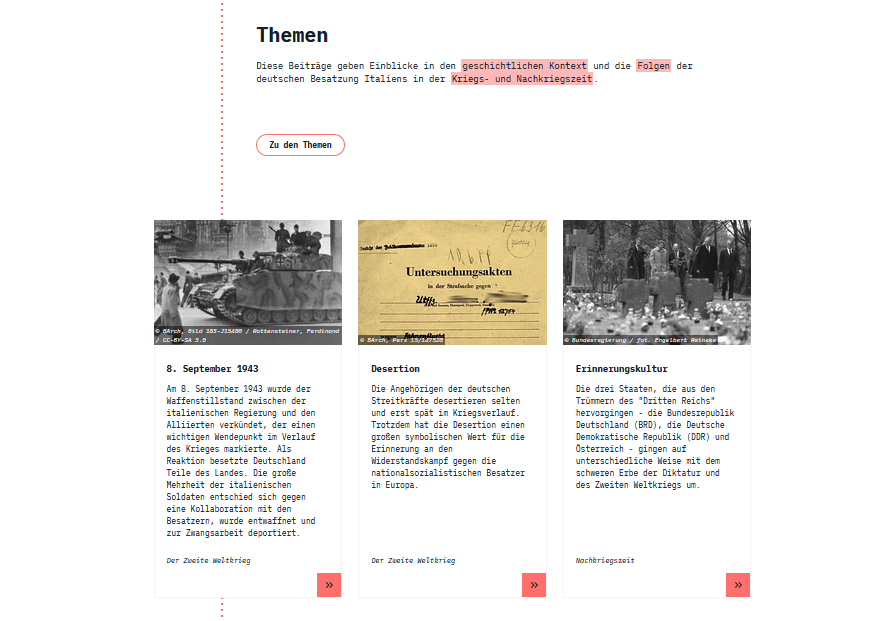
The themes: this section embeds 4 further subsections: the trials for the Monte Sole massacres; memory; German deserters; and the memory of September 8, 1943 from the perspective of the Nazi perpetrators;
The sources: this section includes military and judicial documents, ego-documents, and pictures;
Educational projects: this section lists the activities aimed at handing down the memory of the historical past among the broader public.
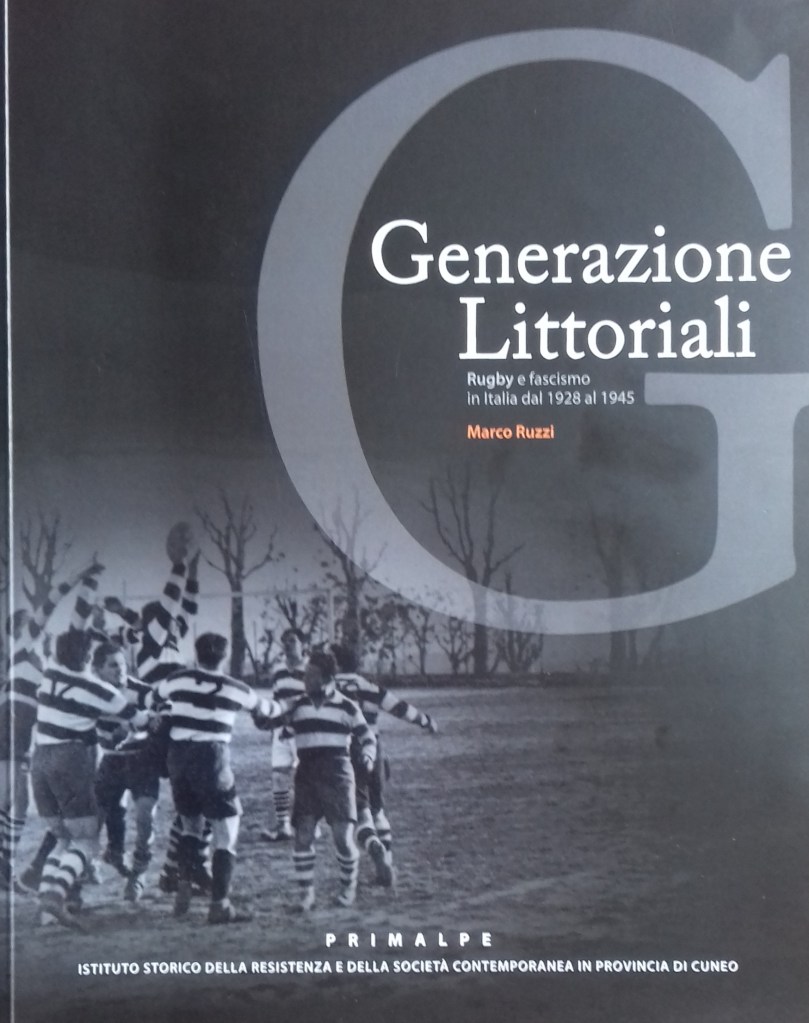
Sport and politics are connected insofar as the latter provides the structural conditions to perform the former: laws, infrastructures, funding, and representation. There is one sombre aspect of this fortunate combination, namely when the political system is a dictatorship. This is the case investigated by Marco Ruzzi in his last book, Generazione Littoriali, in which he unfolds the story of how rugby was introduced to the Italian public and how it developed during the years of fascism and war.
Ruzzi’s book is remarkable in many aspects. The first is the richness of the information that the author provides about a sport that in Italy has occupied a niche, overshadowed by football and other specialities such as athletics or swimming, bicycle races, and Formula 1.


 Close Encounters in War