Exhibition: Creativity and World War II Italian POWs in the United States

The John D. Calandra Italian American Institute, New York

May 1, 2025–September 26, 2025

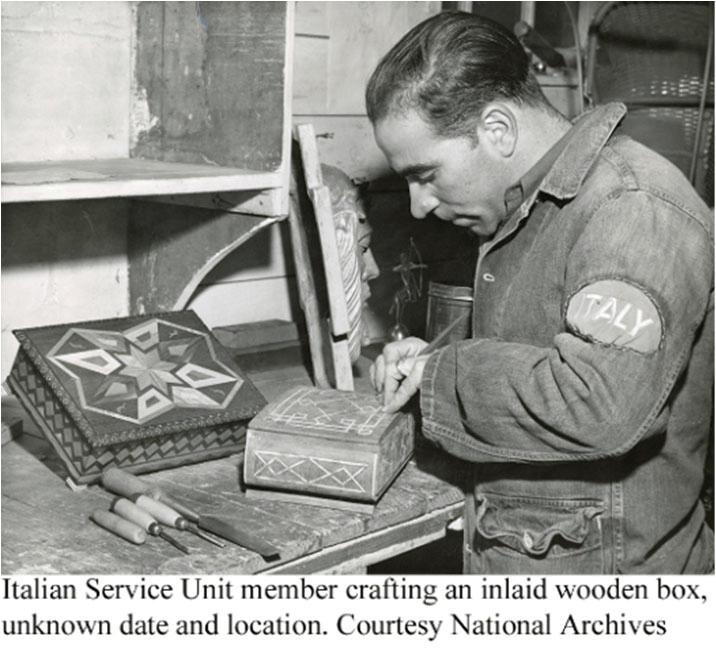
New York, The John D. Calandra Italian American Institute presents its exhibition designed by Polly Franchini Creativity and World War II Italian POWs in the United States, consisting of creative work made by Italian soldiers who were imprisoned by the Allied forces during World War II, with a focus on those held in the United States. These objects, often made from salvaged materials, ranged in size from a small inlaid ring to a large Catholic chapel
with a 65-foot bell tower. The exhibit is based on Dr. Laura E. Ruberto’s (Berkeley City College) research, including historical photographs, rare artefacts, written accounts, and oral testimonies. Dr. Ruberto co-curated the exhibition along with the Calandra Institute’s Dr. Joseph Sciorra.

On view Monday through Friday, 9am to 5pm. The Calandra Institute is located at 25 West 43rd St, 17th floor, in New York City

Download the flyer here

Book Review: “Fascism, the War, and Structures of Feeling in Italy, 1943-1945” by Simonetta Falasca-Zamponi, Oxford, Oxford University Press, 2023

By Gianluca Cinelli

In the wake of recent studies about Italian participation in the Second World War, this volume fills a gap in historical knowledge by focusing on sources that have been neglected or at least not investigated thoroughly and systematically. These sources are diaries that Italian citizens with different social, professional and geographical backgrounds wrote between 25 July 1943 and the end of the war in the spring of 1945. The author analysed 90 diaries (out of 150 consulted) collected at the Archivio della scrittura popolare in Trento, the Archivio diaristico nazionale in Pieve Santo Stefano, and the Archivio Ligure della scrittura popolare in Genoa. The author chose to focus her investigation on diaries because “in a situation characterized by institutional uncertainties and historical unknowns, such as the one Italy faced between 1943 and 1945, feelings of incongruousness and confusion unsettled people’s usual understandings and disrupted their conventional patterns of interpretation and action” (p. 6). Therefore, the day-to-day practice of diary-writing permits her to observe the “ordinary” as it varies across generation, class, and gender and see through these “marginalised narratives” how “people’s interpretation of historical events from the standpoint of their everyday experience affected their responses to those same events and created new political sensibilities” (p. 28). To do that, the author refers to Raymond William’s analytical tool known as “structures of feeling”, a formula cast to convey the idea of the “felt sense of the quality of life” at a particular historical time (p. 4)…

Read the full text here

Book review: “Rome, 16 October 1943. History, Memory, Literature”, by Mara Josi. Cambridge, Legenda, 2023

On Saturday 16 October 1943, the largest single round-up and deportation of Jews from Italy happened. The Germans arrested 1259 people in the Roman ghetto and deported them to Auschwitz-Birkenau. Only 16 survivors, among which one woman, returned after the war.

Mara Josi investigates how 16 ottobre 1943 by Giacomo Debenedetti, La Storia by Elsa Morante, La parola ebreo by Rosetta Loy, and Portico d’Ottavia 13 by Anna Foa have handed down the legacy of the Roman round-up over eighty years.

Read the review here

A New Website is Online: Nazi Massacres in Occupied Italy (1943-1945). The Perpetrators and their Memory

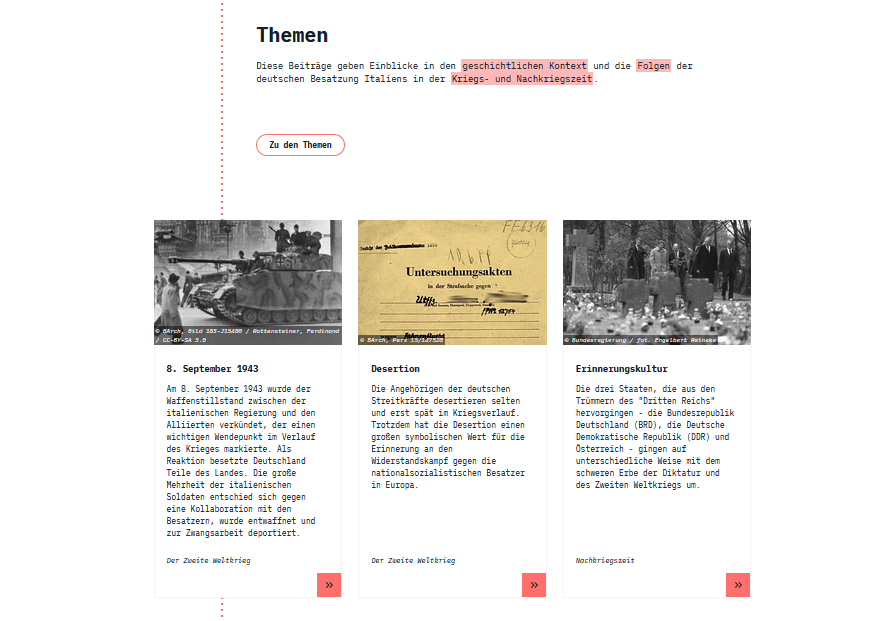
Up to 70,000 Italians fell victim to the German occupation of Italy in the Second World War. More than 10,000 were killed by German troops in massacres and mass executions. Starting on 4 May 2023, texts, photos, biographies of perpetrators, reconstructions of massacres, case studies, and videos on this dark chapter in the history of Germany and Italy will be available at www.ns-taeter-italien.org.

The website was developed in the framework of a project about German massacres in Italy during the Second World War (NS-Täter. Le stragi naziste nell’Italia occupata, 1943-1945 / NS-Täter. Die Massaker im besetzten Italien in der Erinnerung der Täter, 1943-1945), and designed in cooperation with the Berlin-based Lime Flavour agency. From its inception in August 2019, the project has been supported by the German Federal Foreign Office in the framework of the German-Italian Future Fund. Based at the Martin Buber Institute of Jewish Studies (University of Cologne), the project is directed by historian Carlo Gentile in collaboration with journalist Udo Gümpel, and the participation of the Fondazione Scuola di Pace di Monte Sole, and the theatre company Archivio Zeta. At present, the website is accessible in Italian and German but an English version will be soon available for the benefit of the broader public worldwide.

The project addresses different audiences including the general public, educational institutions, memorial sites, and museums. The perpetrators stand at the centre of the historical inquiry: What mentality and psychological dispositions imprinted their actions? What were their social-biographical backgrounds? What room for decision and action was at their disposal? What patterns of legitimation can be identified in their narratives?

The website hosts well-documented historical reconstructions of the Nazi massacres in Italy between 1943 and 1945, based on documentation extracted from forty archives in Germany, Italy, Austria, Great Britain, Russia, and the United States. Such materials include ego-documents, records from the wartime and post-war periods, video recordings, and photos. The digitalisation of the sources is in progress. However, a part of the collection is already available online from the research database Invenio of the German Bundesarchiv. The website is divided into 5 sections:

  1. The massacres: this section presents the stories of the massacres, each of which includes an interactive map, and a synthetic file about the judicial investigations and the people involved. Individual biographies of perpetrators as well as information about Wehrmacht and SS units are provided here along with case studies and the historical reconstruction of the massacres;
  2. The perpetrators: this section provides a list of the Nazi perpetrators with their bios, synthetic personal record, historical info, and pictures;
  3. The themes: this section embeds 4 further subsections: the trials for the Monte Sole massacres; memory; German deserters; and the memory of September 8, 1943 from the perspective of the Nazi perpetrators;
  4. The sources: this section includes military and judicial documents, ego-documents, and pictures;
  5. Educational projects: this section lists the activities aimed at handing down the memory of the historical past among the broader public.

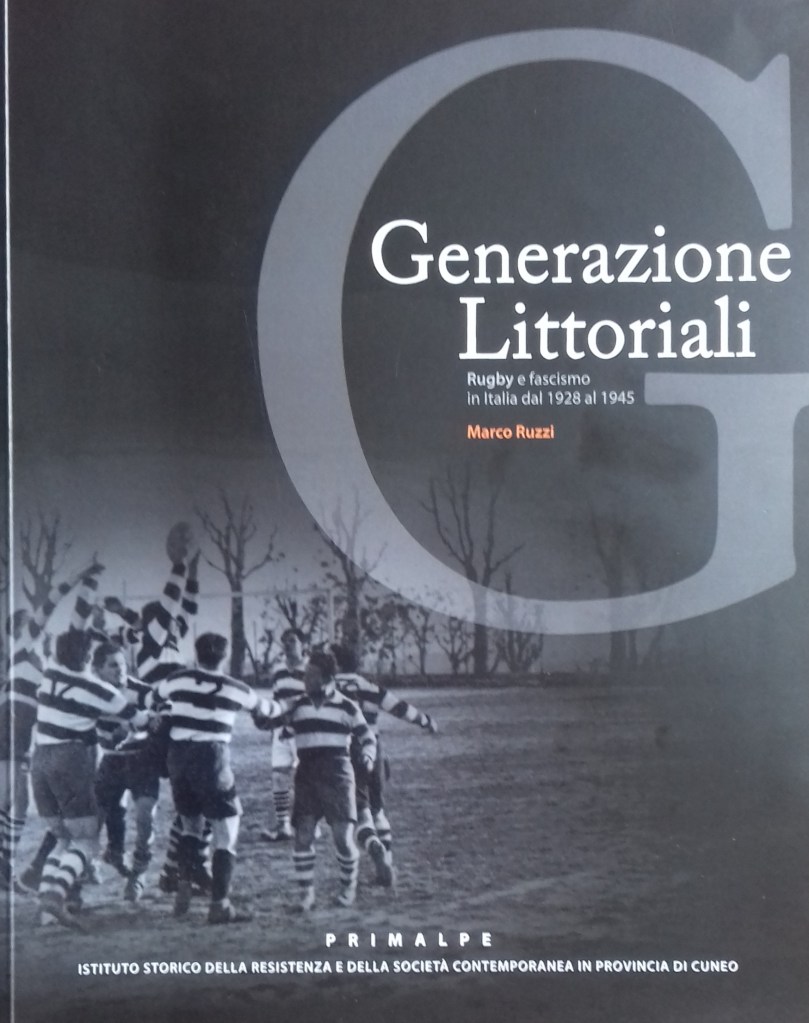
Book Review: Ruzzi, Marco. “Generazione Littoriali. Rugby e fascismo in Italia dal 1928 al 1945”. Cuneo: Primalpe, 2022

By Gianluca Cinelli

Sport and politics are connected insofar as the latter provides the structural conditions to perform the former: laws, infrastructures, funding, and representation. There is one sombre aspect of this fortunate combination, namely when the political system is a dictatorship. This is the case investigated by Marco Ruzzi in his last book, Generazione Littoriali, in which he unfolds the story of how rugby was introduced to the Italian public and how it developed during the years of fascism and war.

Ruzzi’s book is remarkable in many aspects. The first is the richness of the information that the author provides about a sport that in Italy has occupied a niche, overshadowed by football and other specialities such as athletics or swimming, bicycle races, and Formula 1.

Read the full-text review here.

Exhibition in Florence: “Voices of Liberty: Allied Servicemembers of Italian Descent in WWII”

Tuesday April 5, 2022, at 2.30pm – Exhibit hall C.A. Ciampi, Palazzo del Pegaso, via de’ Pucci 16, Florence

Curators Matteo Pretelli and Francesco Fusi

Combatants of Italian descent were present in the various Allied armies that took part in World War II against the Axis Powers. They were mostly sons of emigrants who had left Italy between the late nineteenth and early twentieth centuries. Hundreds of thousands were Italian Americans serving in the U.S. military, but British Italians, Italian Canadians, Italian Australians, and Italian Brazilians also contributed to the war efforts of their countries. Being present in all theatres of the war, they also fought in Italy, a country that many knew only through the stories of their parents. The exhibition reconstructs this fascinating although neglected history by recounting the stories of these men who contributed to the Allied victory.

The exhibition will be open through April 22, 2022, Monday to Friday: 10 am-12 pm and 3-6 pm

Download the flyer here

Book launch: “Il paese dimenticato. Nuto Revelli e la crisi dell’Italia contadina”

Nuto Revelli Foundation – Thursday 17 December 2020, 18 pm.

Live streaming on Zoom and Facebook

On Thursday 17 December, the book Il paese dimenticato. Nuto Revelli e la crisi dell’Italia contadina will be presented online on Zoom, in collaboration with the Nuto Revelli Foundation.

This volume analyses, through Revelli’s published works, interviews, and unpublished archival sources, how he contributed to the national debate about Italy’s industrial revolution, during the 1960s and 1970s.

Nuto Revelli (Cuneo 1919-2004) fought in WW2 as a Second Lieutenant in the Italian Alpine Corps on the Russian front (August 1942 – January 1943). His unit was deployed on the river Don, and as the Red Army broke through the defensive lines of the Axis, Revelli took part in the catastrophic retreat through the steppe in early 1943. As he made it back home, he struggled with PTSD, until the Fascist regime was overturned in July. As Italy exited the war on 8 September 1943, Revelli instinctively decided to leave his hometown and to hide in the mountains, where he founded his first partisan group. After a few months of stalemate, he joined a politically organised partisan group led by two eminent members of the secret antifascist party “Giustizia e Libertà”: Duccio Galimberti and Dante Livio Bianco.

The latter was a lawyer who befriended Revelli and introduced him to a politically aware form of antifascism. Revelli had been an enthusiastic supporter of fascism as a young boy. Only after his disastrous military experience in Russia, he had begun to think critically about Mussolini’s failures. Through the defeat in Russia, Revelli realised that fascism had caused Italy to fall into chaos by deceiving the Italians with its propaganda. His revolt, however, remained for many months instinctive and politically unaware. Only the encounter with Dante Livio Bianco stirred up Revelli’s malcontent and will to revenge, orienting it toward mature political awareness.

The antifascist party “Giustizia e Libertà” was established on principles such as moral intransigence and individual responsibility. The members of this party aimed to educate the youth on ethics and they argued claimed that Italy should become a republican democracy. Revelli poured everything in his partisan experience and was also seriously injured in September 1944, when he had a motorcycle accident that disfigured him.

The partisan war and antifascist education helped Revelli overcome his PTSD. After the war, he became a writer with the two personal narratives Mai tardi (1946, about his war in Russia); and La guerra dei poveri (1962, on his partisan experience). In the 1960s, though, he understood that war testimonies were mostly written by former officers, educated individuals, who had attended school and were used to reading and writing. Privates, who constituted the bulk of the Italian troops and were in large part uneducated and often even illiterate, had not published but very few memoirs. Their war experience remained, for the time being, vastly unknown and neglected by public opinion. Revelli thus found out that the war continued to inflict harm and to kill still many years after its end.

Revelli became an anthropologist and oral historian as he started collecting oral interviews of former Italian soldiers who had fought in Russia. He realised that the Italian post-war society had no interest in listening to the stories of these wrecked men, who often endured PTSD and other physical and spiritual injuries. Many of them were poor peasants, who, after the conflict, came back to a country that they could hardly recognise. In the meantime, Italy had gone under a thorough socio-economic transformation. Since the early 1950s, Italy started its industrial revolution, especially in the northern regions; and manpower was massively drained from the fields, in particular from the most fragile areas of the country, in the South as well as in the North.

Revelli saluted the fact that industrialisation introduced and spread new forms of well-being. Many peasants employed in factories began to collect more solid salaries that helped their families slowly emerge from poverty. However, this revolution imposed its toll. Peasants from the poorer agricultural areas had to decide if either to leave their land and move to the industrial cities in the North industrial workers; or to keep working in the fields part-time, alternating this job with shifts in the factories.

The reason for such a dramatic situation was due to the international political context in which Italy’s industrialisation unfolded. On the one hand, the American Marshall Plan aimed to transform the agricultural economies in the poorer countries (like Italy) into industrialised economic activities. As a consequence, the first accords of the European Economic Community in the 1950s designed the agricultural development strategies in terms of very competitive liberalism. That meant that those areas where agriculture was thriving received economic and technical support to grow faster and stronger into industrial establishments. The poor rural areas, though, did not receive the same support, so their population was forced to move to the cities and to transform quickly into industrial manpower. Quite cruelly, rural economists used to say, still in the 1960s, that the archaic rural economy had to become extinct through depopulation.

Unfortunately, not everyone was able to leave their fields and homes and move to the cities. Many elderly peasants had made sacrifices to buy their fields and homes and now were too old to become factory workers. Moreover, a relevant number of those peasants were WW2 veterans struggling with PTSD and chronic diseases. Peasant women in these rural areas were mostly illiterate too. In the 1950s, the Italian peasant culture still rested on ancient traditions including rigid religiousness and superstition. That culture exploited children as workers and confined women in the house under harsh conditions of ignorance and hard physical labour.

Revelli felt indignation as he discovered this concealed world existing almost unnoticed just outside his hometown. A few kilometres beyond the wealthy agricultural establishments in the plains, the rural world that showed itself on the hills and mountains was comparable to a medieval society. Revelli did not accept that the national political and economic agenda could leave these people to their extinction, just because they would not adapt to the new model of economic growth.

He devoted four books to the people of the archaic rural areas of his region, Piedmont: La strada del davai (1966, forty interviews with veterans from the Russian front and captivity – translated into English as Mussolini’s Death March); L’ultimo fronte. Lettere di soldati dispersi o caduti nella seconda guerra mondiale (1971, collecting about 1300 letters from KIA or MIA Italian soldiers); Il mondo dei vinti. Testimonianze di vita contadina (1977, over 200 oral testimonies from elderly peasants); and L’anello forte. La donna. Storie di vita contadina (1985, more than 200 oral interviews with female peasants).

Nuto Revelli today represents one important critical voice insofar as he reminds us that no one should be left behind in the name of economic growth. No well-being is such if it can be benefited only by the happy few to the detriment of the others.
New publication on Primo Levi

Innesti. Primo Levi e i libri altrui, ed. by Gianluca Cinelli and Robert S. C. Gordon, Oxford, Peter Lang, 2020

Primo Levi’s work presents an extraordinarily rich and articulated case of intertextuality. Being a curious, omnivorous, and asystematic reader, Levi explored multiple fields of knowledge – literary, scientific, historical, etc. – browsing between specialized and popular books and magazines, for reasons of research or pure entertainment, often approaching foreign cultures in the original language, driven by his eclectic curiosity and an intense desire to know and understand. Already fathomed in part by Levi himself in his anthology The Search for Roots (1981), his library remains however to be discovered. This volume intends to trace the features of a critical map of the grafts, intertexts and transplants that link Levi’s work to the books of others, by comparing it with twenty-one authors, in a “polyglot and multipurpose” gallery that includes classics such as Dante, Shakespeare, Leopardi, Baudelaire, and Carroll; authors of modern literature such as Kafka, Mann, and Calvino; and scientists such as Galileo, Darwin, Heisenberg, and Lorenz.

Table of contents

Domenico Scarpa: Prefazione xi
Gianluca Cinelli e Robert S. C. Gordon: Introduzione 1

Parte I – Gli strumenti umani
Antonio Di Meo: Primo Levi e William Henry Bragg 19
Mario Porro: Primo Levi e Galileo Galilei 37
Patrizia Piredda: Primo Levi e Werner Heisenberg 55
Alberto Cavaglion: Primo Levi e Giuseppe Gioachino Belli 73
Enzo Ferrara: Primo Levi e Stanislaw Lem 87
Stefano Bartezzaghi: Primo Levi e Lewis Carroll 107


Parte II – La condizione umana
Vittorio Montemaggi: Primo Levi e Dante 127
Valentina Geri: Primo Levi e William Shakespeare 143
Simone Ghelli: Primo Levi e Pierre Bayle 161
Martina Piperno: Primo Levi e Giacomo Leopardi 179
Damiano Benvegnù: Primo Levi e Konrad Lorenz 197
Pierpaolo Antonello: Primo Levi e Charles Darwin 215

Parte III – Comprendere e narrare il Lager
Charles L. Leavitt IV: Primo Levi e Elio Vittorini 237
Uri S. Cohen: Primo Levi e Vercors 255
Sibilla Destefani: Primo Levi e Charles Baudelaire 273
Stefano Bellin: Primo Levi e Franz Kafka 287
Davide Crosara: Primo Levi e Samuel Beckett 305

Parte IV – La ricerca di sé
Martina Mengoni: Primo Levi e Thomas Mann 327
Gianluca Cinelli: Primo Levi e Herman Melville 345
Mattia Cravero: Primo Levi e Ovidio 361
Marco Belpoliti: Primo Levi e Italo Calvino 381

Biografie degli autori 403
Indice dei nomi 407

An unusual close encounter with the enemy

Nuto Revelli’s Il disperso di Marburg after 25 years. Marburg, July 18, 2019

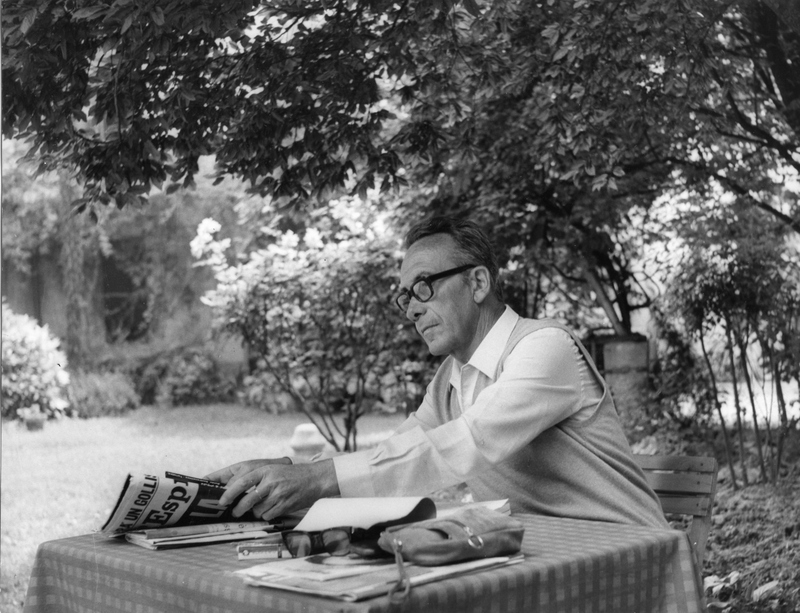
Nuto Revelli.

Nuto Revelli (Cuneo 1919-2004) was an officer of the Italian Royal Army and fought in Russia in 1942-1943. Following the armistice of September 8, 1943 between Italy and the Allies, Revelli joined the anti-fascist partisan groups and fought as commander of the 4th GL Band (later renamed “Carlo Rosselli” Brigade) until the liberation of Italy in April 1945. The experience of war engendered deep hatred against the Germans, which Revelli had met on the Russian front as allies and then as enemies in the mountains of his region (Piedmont). For decades this hatred remained unchanged and the intensity of such feeling was captured in the first books that Revelli published in the post-war period, Mai tardi (1946 and then republished in 1967) and La guerra dei poveri (1962). In these books the Germans are represented as cruel beasts, enemies to hate and despise.

In the 1980s, while collecting oral accounts from peasants in the Alpine valleys of Piedmont, Revelli heard from a former partisan a strange war story, the legend of a German officer who rode off in the countryside and who was kind to the local inhabitants and children, a peaceful and apparently “good” man. One day of 1944 this man disappeared, possibly killed in an ambush of partisans, and since then no one knew anymore about him. This legend disturbed Revelli because it challenged his memories of war and seemed too lenient to be true. Nevertheless, it was the story of a missing-in-action soldier. The memory of soldiers missing in Russia during the retreat from the Don River had tormented Revelli since the end of the war. A missing soldier, the writer said, is the cruellest legacy of any war.

Thus, he decided to engage in the search for the identity of this missing man, and after ten years of work, oral interviews with witnesses and research in German military archives, he succeeded. He discovered that the missing man was a 23-year-old German officer, a student who had not joined the National Socialist Party, who was not enthusiastic about the war and had already lost his older brother in Russia. A young man like so many others, who had been involved into the enormity of the war and had been overwhelmed by a cruel fate.

Fifty years after the war, Revelli thus found the way to reconcile with the hated enemy through a historical quest that in the end also turned out to be an experience of friendship, as far as he befriended the German historian Christoph Schminck-Gustavus, who remained close to Revelli. And, above all, this was a story of reconciliation with the human side of the so-called enemy. The book that tells this story, Il disperso di Marburg, was published in 1994 and for the occasion Revelli visited the German town of Marburg where Rudolf Knaut, the missing officer, was born. This year, on July 18, Marburg hosted an event dedicated to Revelli and to Il disperso di Marburg to celebrate the centenary of the writer’s birth (July 21). Gianluca Cinelli gave two lectures at the Institut für romanische Philologie at Philipps-Universität Marburg and at the Technologie- und Tagungszentrum in the presence of a large audience.

New article: “Das Bild des italienischen Soldaten im deutschsprachigen Diskurs über die Vergangenheitsverwaltung”

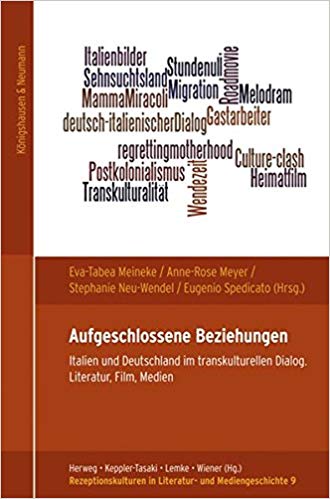
Das Bild des italienischen Soldaten im deutschsprachigen Diskurs über die Vergangenheitsverwaltung, in Aufgeschlossene Beziehungen. Deutschland und Italien im transkulturellen Dialog. Literatur, Film, Medien, ed. by Tabea Meineke, Anne-Rose Meyer-Eisenhut, Stephanie Neu-Wendel and Eugenio Spedicato, Würzburg, Verlag Königshausen & Neumann, 2019, 67-80

Among the contributions appeared in the book Aufgeschlossene Beziehungen (Open-minded Relationships), devoted to the exploration of the way in which the Italian and German cultures have built their transcultural dialogue since WW2, one chapter by Gianluca Cinelli investigates how German post-war narratives, both literary and historical, represented the Italian soldiers in a very negative way, thus paving the way to the consolidation of an old anti-Italian prejudice spread all over Germany. The German combatants came across the Italians during WW2 as allies between 1940 and September 8, 1943, when Italy surrendered to the Allies. What emerges from this contribution is that little attention has been paid in Germany to this topic. Nonetheless, Italian soldiers were represented as lazy and unfit for war, unworthy in battle and unreliable as allies, cowardly and too soft to endure the hardship of modern warfare. And even worse, they were depicted as traitors following Italy’s withdrawal from the conflict in 1943, after which a remarkable number of Italians began to fight against the Germans as partisans.

The chapter builds on historical and literary sources, by combining the testimonies of former German cambatants (from privates of the Afrikakorp to memoirs of such Whermacht higher officers as Rommel or Kesselring) with historic evidence collected by mainly German scholars (from Hammerman to Klinkhammer and Schlemmer). The main thesis of the chapter consists in claiming that the anti-Italian prejudice largely depended on the effectiveness of Nazi propaganda and on the circulation of a number of testimonies that depicted the Italians as inferiors not only as for their military virtues but also on a racial basis. In the end, only the massive integration of Italian immigrants starting from the 1950s began to challenge the dominant stereotype and to rehabilitate the memory of the former allies-and-enemies as human beings and fellow citizens.