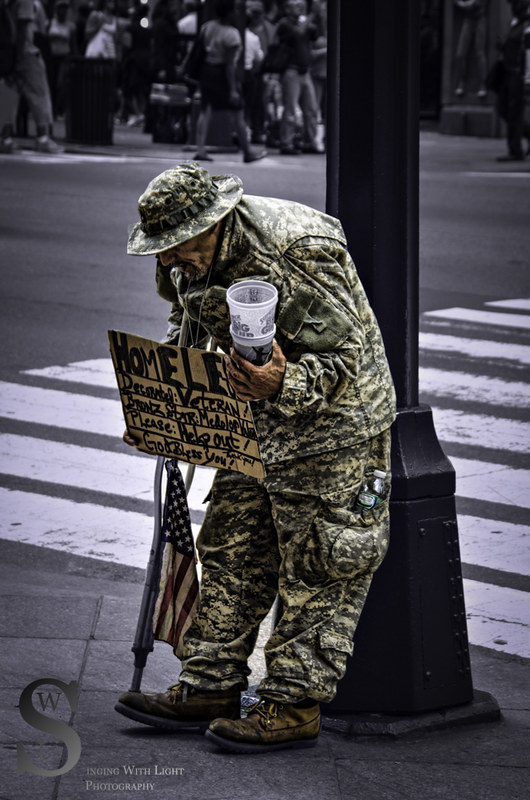
“Boots”. A short story by DC Diamondopolous

Common Creatives CC BY-NC-ND 2.0

The same sun scorched downtown Los Angeles that had seared the Iraq desert. Army Private First Class Samantha Cummings stood at attention holding a stack of boxes, her  unwashed black hair slicked back in a ponytail and knotted military style. She stared out from Roberts Shoe Store onto Broadway, transfixed by a homeless man with hair and scraggly beard the color of ripe tomatoes. She’d only seen that hair color once before, on Staff Sergeant Daniel O’Conner.

      The man pushed his life in a shopping cart crammed with rags and stuffed trash bags. He glanced at Sam through the storefront window, his bloated face layered with dirt. His eyes had the meander of drink in them.

      Sam hoped hers didn’t. Since her return from Bagdad a year ago, her craving for alcohol sneaked up on her like an insurgent. Bathing took effort. She ate to exist. Friends disappeared. Her life started to look like the crusted bottom of her shot glass.

      The morning hangover began its retreat to the back of her head.

      The homeless man vanished down Broadway. She carried the boxes to the storeroom.

      In 2012, Sam passed as an everywoman: white, black, brown, Asian. She was a coffee colored Frappuccino. Frap. That’s what the soldiers nicknamed her. Her mother conceived her while on ecstasy during the days of big hair and shoulder pads. On Sam’s eighteenth birthday, she enlisted in the Army. She wanted a job and an education. But most of all she wanted to be part of a family…

Read the short story as a PDF

“Lioness”. Flash Fiction

By Scott Rye

It wasn’t so much that Betty Lynn Campbell was pretty. She wasn’t. But there was something about her. On her best days, she bore a slight resemblance to a young Meryl Streep. Probably the Polish genes inherited from her mother. No, Betty Lynn wasn’t pretty. What she was, though, was a dude magnet. She was never going to be Homecoming Queen, but she was popular with the football players. Slut? Whore? Easy? Nobody ever used those words, exactly, when describing Betty Lynn. “Animal magnetism”, maybe. That’s what she had, they said. And it was true that she seemed to exude some sort of literal magnetism: Betty Lynn was unable to wear a watch because it would stop working within a day or two of putting it on. Doctors were at a loss to explain the phenomenon…

Read the full story here

“Overnight with Mya”, a story -as raw as war- by US Vietnam veteran “No Socks”

Take me out of here! This pin gun flare behind your ear will blow your nose from this end. Drive asshole! Now, that we are clear of your black pajama cowboy boyfriends, let’s get real. You were setting me up.

Take me to the address on the paper I gave you. You wanted those cowboys to kill me and take my money. Well, asshole you picked the wrong guy. Now take me to that address or I will blow your head off and steal your taxi. I’m staying in Saigon tonight.

I remember getting out of the cab with pounding in my chest. Fearful and pumped. I was trying to meet up with my special bar girl. Her name is Mya, or at least that is what I call her at the bar. She takes good care of me. The bar girls are our main source of bought affection. Mya is my favorite. She is older, maybe twenty-eight. She supplies affection and tending for money. All the bar girls smell good and flirt with us. When you are thousands of miles from round eyed girls your age, Vietnamese bar girls are very desirable. They are in the war also. They sell their bodies for money to survive. Women have few legit jobs in the city. They make their money off G.I.s. that get time off and can get into Saigon. American CIA and government officials do not indulge in bar girls. They are big time. Most have a Vietnamese girl friend that they maintain in high style. I bet they do not write home about those arrangements…

Read the story here

A Short Guide to Successful Gardening in the Time of War

By Olga Kornyushyna, in loving memory of Andriy Romanov, killed in action April 26, 2024

Courtesy by Olga Kornyushyna©

Between the day we received Olga’s story and today, the gardening company in Odessa mentioned in the text was destroyed during the Russian air strike on May 1, 2024. Thousands of plants and trees were burned, warehouses and offices destroyed. Luckily there were no casualties among the employees. The owners of the company released a video of the aftermath of the attack. 

Read A Short Guide to Successful Gardening in the Time of War

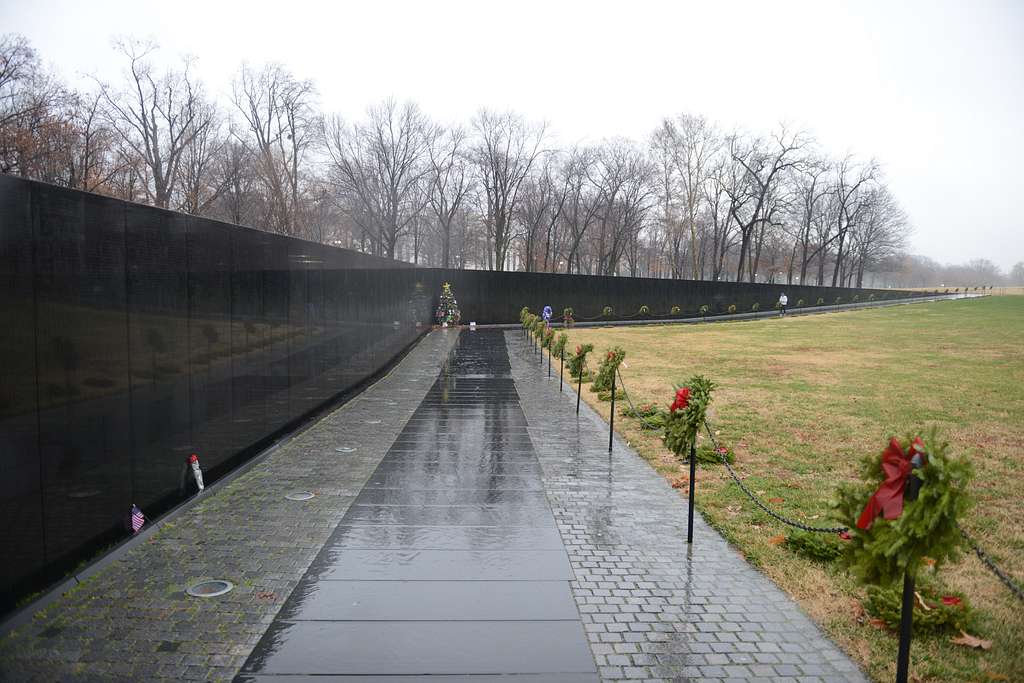
A testimony: “The Wall” by Lawrence Markworth

Lawrence Markworth served in the US Navy between 1962 and 1966 and participated in the Vietnam War on the USS Castor. After struggling for decades with his traumatic memories, he eventually reconnected with his younger self, who had gone through the ordeal of war. We publish here a short autobiographical testimony of Lawrence’s journey, which was extracted from his forthcoming memoir Rowing through a Sea of Rubble.

Read The Wall by Lawrence Markworth

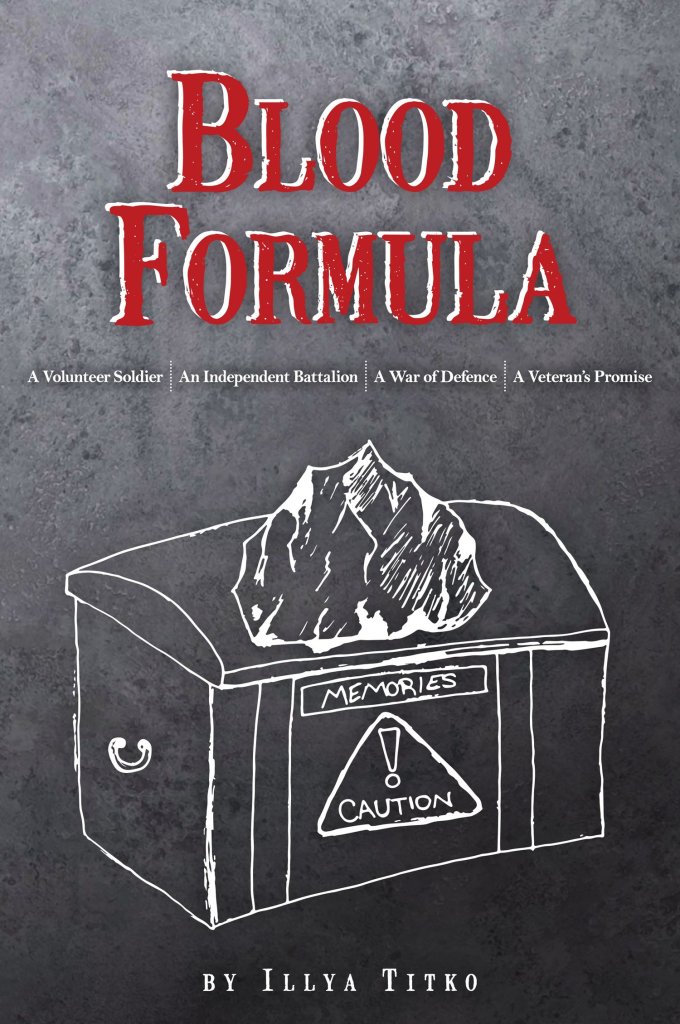
Book Review: Illya Titko, “Blood Formula”, translated by Jeffrey Stephaniuk, Regina, Benchmark Press, 2021, 210 p.

By Gianluca Cinelli

Senior Lieutenant Illya Titko is a combat veteran from Kalush, Ivano-Frankivsk Oblast, Ukraine. He was drafted in September 2015, or rather, he volunteered for the mobilization that was underway. Mr. Titko writes his book from the per­spective of a citizen-soldier, as a man who continued to maintain one foot firmly in the civilian world, even though his new environment was a war zone, and “war is when your entire world is turned upside down.”

Jeffrey Stephaniuk, the excellent translator of this book, introduces with these words the author (at p. 6), highlighting the perspective from which the whole story is told: that of a “citizen in arms”, a man who has answered the impellent call of duty when his country was in dire danger. Titko himself adds some remarks a few pages later:

It was not an easy task for me to write this book. It was a real inner struggle, for over a year, on whether I should write it or not. But I was pre-occupied with those past events, mulling that chaotic time over and over in my mind, conscious of the fact that it really wasn’t that long ago when I lived through them. There were nights when I couldn’t even sleep. I’d argue with myself: Should I or should I not write this book? I clearly understood that not only should I write this book, but it was nec­essary for this book be written. First, it was necessary so that everything I ex­perienced would have its place and not become lost in the subsequent living of my everyday life. I needed to write this book so that those who hadn’t been there personally could know about these events. I wanted them to know what happened and how they happened to those involved, with the people, with the country, and of course all those individuals who resolved to walk this same path, namely sol­diers defending their country. I realized that such a book would be necessary for children, grandchildren, and great grandchildren, so that they would have access to first-hand accounts about these difficult and stormy days and nights in the history of our nation. (12)

Read the review here

Launch of new journal section: “Back to the light. Stories of healing from trauma”

War affects our world and lives, whether we are directly involved or not. Its effects are like those of a disease that spreads through the organism, weakening it and altering its relationship with the environment. War destroys communities, poisons associated life, and builds walls. And, which is worse, it plants rotten seeds from which bitter fruits will grow. One antidote to the spread of its malice is listening to the stories of those who have seen its very Gorgon’s face and suffered from its scorching touch.

The Close Encounters in War Journal inaugurates a new section called Back to the light. Stories of healing from trauma. It is entirely devoted to the stories of people who have experienced the war and learned how to cope with the burden of its traumatic memories. Sharing these stories means much to the authors both in terms of ethical commitment and psychological effort. They reveal something intimate that has been troubling them, a core of traumatic memories that haunt their lives. Nonetheless, they are eager to share their stories worldwide with a public of interested and empathic readers, who want to listen and know what war is about.

We are happy to launch this project with two contributions by Ukrainian refugee Olga Kornyushyna and American former infantryman Charles Collins. Olga tells about her traumatic encounter with war as a civilian who had to flee from Kyiv, bombed by the Russians in the present war. Charles tells how he went through four turns of deployment overseas and how he had to fight to heal the moral wounds that such experiences inflicted on him.

The editors of the CEIWJ would like to express their profound gratitude to the authors of these stories and invite all who have stories of healing from war trauma to share them with us and our readers. Veterans, families, friends, therapists, and healers are welcome to submit their contributions.

Our gratitude also goes to Ed Tick, who has generously accepted to embark on this endeavour as co-editor of the Back to the light project, and the members of the section-specific editorial board, Charles Aishi Blocher, Kate Dahlstedt, Nathan Graeser, Lawrence Markworth, Donald McCasland, Glen Miller, Roxy Runyan, and Floyd Striegel.

Back to the light. Stories of healing from trauma

DC Diamondopolous, Boots (January 9, 2026)

Karly Randolph Pitman, Market Day (6 June 2025)

Charles Aishi Blocher, Where is Your Combat Zone? (10 July 2024)

Olga Kornyushyna, A Short Guide to Successful Gardening in the Time of War (7 May 2024)

Everett Cox, On Becoming a Veteran (2 February 2024)

Steven Gunn, A Disquieted Mind (11 April 2023)

Charles “Chuck” Collins, Coming Home Hard (19 November 2022)

Olga Kornyushyna, There Are No Atheists in the War Zone (12 November 2022)

“Burial at Sea”, by Lawrence Markworth

An old warrior, relegated to obscurity in the backwaters of San Diego Bay with the rest of the Navy’s unwanted fleet, waited. A destroyer, unable to serve her country after a crippling collision that amputated most of her bow, the USS Tingey was disabled, decommissioned, and cast aside. Guns removed from her decks, stripped of every piece of machinery of value, no longer able to fight, she lay naked, aging, and lonely, secretly wishing for rehabilitation or death. From her remaining superstructure, she could occasionally see the proud fleet leaving the bay for the real action in the South China Sea. She longed to be with them, cutting the waves at 30-plus knots, protecting aircraft carriers, looking for Russian submarines, or shelling the enemy in some far-away jungle. Instead, rust ran rampant through her decks, passageways, bulkheads and bilges, eating away at her insides like an inoperable cancer. But the worst was the neglect. No one worked on her, no one visited, no one cared. Nothing but silence, except for the occasional wave lapping at her rust-oozing sides, as a tugboat brought in another old hulk. How long could this idleness and humiliation last?

Continue reading the full text here