For the 75th anniversary of D-Day, the Library of Congress published a webpage titled Experiencing War. Researchers and anyone who is interested can access 12 collections with diaries, photos and oral histories of men and women who experienced that event.
The materials are part of one of the Library of Congress’ special projects: the Veterans History Project (VHP), part of the American Folklife Center, which collects personal accounts of American war veterans with the aim to preserve the memories of war and conflicts in which the United States took part, from the First World War up to the wars in Iraq and Afghanistan. The VHP’s materials provide a wealth of sources for researchers who work on experiences of war, and many of those can be accessed remotely through their website: https://www.loc.gov/vets/
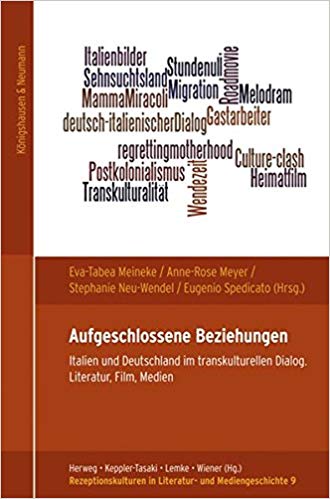
Das Bild des italienischen Soldaten im deutschsprachigen Diskurs über die Vergangenheitsverwaltung, in Aufgeschlossene Beziehungen. Deutschland und Italien im transkulturellen Dialog. Literatur, Film, Medien, ed. by Tabea Meineke, Anne-Rose Meyer-Eisenhut, Stephanie Neu-Wendel and Eugenio Spedicato, Würzburg, Verlag Königshausen & Neumann, 2019, 67-80
Among the contributions appeared in the book Aufgeschlossene Beziehungen (Open-minded Relationships), devoted to the exploration of the way in which the Italian and German cultures have built their transcultural dialogue since WW2, one chapter by Gianluca Cinelli investigates how German post-war narratives, both literary and historical, represented the Italian soldiers in a very negative way, thus paving the way to the consolidation of an old anti-Italian prejudice spread all over Germany. The German combatants came across the Italians during WW2 as allies between 1940 and September 8, 1943, when Italy surrendered to the Allies. What emerges from this contribution is that little attention has been paid in Germany to this topic. Nonetheless, Italian soldiers were represented as lazy and unfit for war, unworthy in battle and unreliable as allies, cowardly and too soft to endure the hardship of modern warfare. And even worse, they were depicted as traitors following Italy’s withdrawal from the conflict in 1943, after which a remarkable number of Italians began to fight against the Germans as partisans.
The chapter builds on historical and literary sources, by combining the testimonies of former German cambatants (from privates of the Afrikakorp to memoirs of such Whermacht higher officers as Rommel or Kesselring) with historic evidence collected by mainly German scholars (from Hammerman to Klinkhammer and Schlemmer). The main thesis of the chapter consists in claiming that the anti-Italian prejudice largely depended on the effectiveness of Nazi propaganda and on the circulation of a number of testimonies that depicted the Italians as inferiors not only as for their military virtues but also on a racial basis. In the end, only the massive integration of Italian immigrants starting from the 1950s began to challenge the dominant stereotype and to rehabilitate the memory of the former allies-and-enemies as human beings and fellow citizens.
Lo sguardo lontano. L’Italia della Seconda guerra mondiale nella memoria dei prigionieri di guerra
For those who are interested in Italian history and the memories of prisoners of war (and for those who can read the Italian language), we are pleased to announce the publication of a new open-access book:Lo sguardo lontano. L’Italia della Seconda guerra mondiale nella memoria dei prigionieri di guerra, by Erika Lorenzon (Edizioni Ca’ Foscari Digital Publishing).
On 22nd June 1941, the German armies overcame the Russian resistance on the river Bug and started to penetrate in depth in Russia in a drunken state of exaltation. It was the triumph of the Blitzkrieg which many generals considered the only true form of military art, according to the legacy of Clausewitz and Schlieffen: the dimension of the attack was such that the commanders ignored what other units were doing, and the common motto was “forward, no matter what the others do”, in order to annihilate the enemy before this could strike back. For many a soldier this unstoppable advance was just a leap into the void, because after leaving the last villages of the Reich they found themselves alone in the vastness of an unknown land…
When he stopped his studies of engineering in Manchester, Wittgenstein moved to Cambridge to study logic under the guidance of Bertrand Russell because he believed that by comprehending the fundamentals of language, and therefore the limits of language, he would understand its essence, as well as that of human beings, in primis, himself…
The letters sent from the front during WWII constitute a broad universe which we are just partially familiar with (tens of thousands of letters out of billions). Only a very small portion of the immense corpus of letters from and to the fronts has been published, which means that such a form of testimony constitutes an important but also distorted means of encounter with war. Do therefore letters constitute a good means for encountering war? Do people at home really come across war, when they read the letters received from their loved ones at the front?…


 Close Encounters in War