War Diary: The Diary of Mike Rogers

By Alan Beardsley

“War Diary: The Diary of Mike Rogers” is a compelling personal narrative that offers an intimate glimpse into the life and experiences of Michael John Warrington Rogers during World War II. Spanning from the outbreak of WW2 in 1939, to the end of 1945 and the dropping of the atomic bombs, War Diary: The Diary of Mike Rogers entries chronicle the daily realities of war, from the grand strategic movements of the Allied forces to the personal struggles and moments of respite that defined his existence.

Through Mike Rogers’ eyes, readers are transported to the front lines of pivotal events such as the Dunkirk Evacuations, The Blitz and later in the War, the Battle of Normandy, the liberation of Paris, and the harrowing Battle of the Bulge. His reflections on the relentless V2 bombings and the bold, albeit ultimately unsuccessful, German Operations provide a vivid account of the war’s impact on civilians.

The accompanying website, www.wardiaryonline.com, serves as a digital archive and interactive platform where readers can explore additional content, including photographs, historical documents, and detailed maps. The website also invites contributions from those with connections to the events described, enriching the narrative with personal stories and memorabilia.

“War Diary: The Diary of Mike Rogers” is more than just a historical document; it is a testament to the resilience and determination of individuals facing extraordinary circumstances. Through Mike Rogers’ detailed and poignant entries, “War Diary: The Diary of Mike Rogers” offers a powerful and personal perspective on World War II, making it an essential addition to the study of personal narratives in wartime history.

“War Diary: The Diary of Mike Rogers” stands out for its raw, unfiltered portrayal of wartime life. The War Diary: The Diary of Mike Rogers project not only preserves the legacy of those who lived through these tumultuous times but also provides invaluable insights into the human condition under the pressures of war.

A New Website is Online: Nazi Massacres in Occupied Italy (1943-1945). The Perpetrators and their Memory

Up to 70,000 Italians fell victim to the German occupation of Italy in the Second World War. More than 10,000 were killed by German troops in massacres and mass executions. Starting on 4 May 2023, texts, photos, biographies of perpetrators, reconstructions of massacres, case studies, and videos on this dark chapter in the history of Germany and Italy will be available at www.ns-taeter-italien.org.

The website was developed in the framework of a project about German massacres in Italy during the Second World War (NS-Täter. Le stragi naziste nell’Italia occupata, 1943-1945 / NS-Täter. Die Massaker im besetzten Italien in der Erinnerung der Täter, 1943-1945), and designed in cooperation with the Berlin-based Lime Flavour agency. From its inception in August 2019, the project has been supported by the German Federal Foreign Office in the framework of the German-Italian Future Fund. Based at the Martin Buber Institute of Jewish Studies (University of Cologne), the project is directed by historian Carlo Gentile in collaboration with journalist Udo Gümpel, and the participation of the Fondazione Scuola di Pace di Monte Sole, and the theatre company Archivio Zeta. At present, the website is accessible in Italian and German but an English version will be soon available for the benefit of the broader public worldwide.

The project addresses different audiences including the general public, educational institutions, memorial sites, and museums. The perpetrators stand at the centre of the historical inquiry: What mentality and psychological dispositions imprinted their actions? What were their social-biographical backgrounds? What room for decision and action was at their disposal? What patterns of legitimation can be identified in their narratives?

The website hosts well-documented historical reconstructions of the Nazi massacres in Italy between 1943 and 1945, based on documentation extracted from forty archives in Germany, Italy, Austria, Great Britain, Russia, and the United States. Such materials include ego-documents, records from the wartime and post-war periods, video recordings, and photos. The digitalisation of the sources is in progress. However, a part of the collection is already available online from the research database Invenio of the German Bundesarchiv. The website is divided into 5 sections:

  1. The massacres: this section presents the stories of the massacres, each of which includes an interactive map, and a synthetic file about the judicial investigations and the people involved. Individual biographies of perpetrators as well as information about Wehrmacht and SS units are provided here along with case studies and the historical reconstruction of the massacres;
  2. The perpetrators: this section provides a list of the Nazi perpetrators with their bios, synthetic personal record, historical info, and pictures;
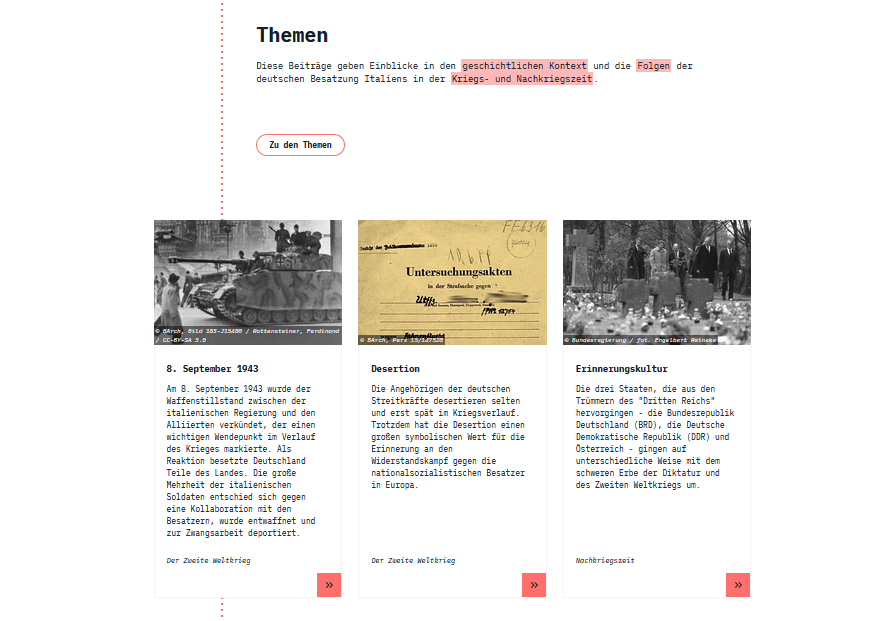
  3. The themes: this section embeds 4 further subsections: the trials for the Monte Sole massacres; memory; German deserters; and the memory of September 8, 1943 from the perspective of the Nazi perpetrators;
  4. The sources: this section includes military and judicial documents, ego-documents, and pictures;
  5. Educational projects: this section lists the activities aimed at handing down the memory of the historical past among the broader public.

Launch of new journal section: “Back to the light. Stories of healing from trauma”

War affects our world and lives, whether we are directly involved or not. Its effects are like those of a disease that spreads through the organism, weakening it and altering its relationship with the environment. War destroys communities, poisons associated life, and builds walls. And, which is worse, it plants rotten seeds from which bitter fruits will grow. One antidote to the spread of its malice is listening to the stories of those who have seen its very Gorgon’s face and suffered from its scorching touch.

The Close Encounters in War Journal inaugurates a new section called Back to the light. Stories of healing from trauma. It is entirely devoted to the stories of people who have experienced the war and learned how to cope with the burden of its traumatic memories. Sharing these stories means much to the authors both in terms of ethical commitment and psychological effort. They reveal something intimate that has been troubling them, a core of traumatic memories that haunt their lives. Nonetheless, they are eager to share their stories worldwide with a public of interested and empathic readers, who want to listen and know what war is about.

We are happy to launch this project with two contributions by Ukrainian refugee Olga Kornyushyna and American former infantryman Charles Collins. Olga tells about her traumatic encounter with war as a civilian who had to flee from Kyiv, bombed by the Russians in the present war. Charles tells how he went through four turns of deployment overseas and how he had to fight to heal the moral wounds that such experiences inflicted on him.

The editors of the CEIWJ would like to express their profound gratitude to the authors of these stories and invite all who have stories of healing from war trauma to share them with us and our readers. Veterans, families, friends, therapists, and healers are welcome to submit their contributions.

Our gratitude also goes to Ed Tick, who has generously accepted to embark on this endeavour as co-editor of the Back to the light project, and the members of the section-specific editorial board, Charles Aishi Blocher, Kate Dahlstedt, Nathan Graeser, Lawrence Markworth, Donald McCasland, Glen Miller, Roxy Runyan, and Floyd Striegel.

Back to the light. Stories of healing from trauma

Karly Randolph Pitman, Market Day (6 June 2025)

Charles Aishi Blocher, Where is Your Combat Zone? (10 July 2024)

Olga Kornyushyna, A Short Guide to Successful Gardening in the Time of War (7 May 2024)

Everett Cox, On Becoming a Veteran (2 February 2024)

Steven Gunn, A Disquieted Mind (11 April 2023)

Charles “Chuck” Collins, Coming Home Hard (19 November 2022)

Olga Kornyushyna, There Are No Atheists in the War Zone (12 November 2022)

Announcement: Experiencing War at the Library of Congress

For the 75th anniversary of D-Day, the Library of Congress published a webpage titled Experiencing War. Researchers and anyone who is interested can access 12 collections with diaries, photos and oral histories of men and women who experienced that event.

The page can be accessed at this link: https://www.loc.gov/vets/stories/ex-war-dday75.html

The materials are part of one of the Library of Congress’ special projects: the Veterans History Project (VHP), part of the American Folklife Center, which collects personal accounts of American war veterans with the aim to preserve the memories of war and conflicts in which the United States took part, from the First World War up to the wars in Iraq and Afghanistan. The VHP’s materials provide a wealth of sources for researchers who work on experiences of war, and many of those can be accessed remotely through their website: https://www.loc.gov/vets/