“Shared in Shards”:  Fragments from the War in Ukraine.

Review of Oksana Maksymchuk’s Still City, Diary of an Invasion

By Sarah Montin
Are they there yet?” is the question haunting Oksana Maksymchuk’s debut collection in English which chronicles the period just before and after Russia’s invasion of Ukraine in February 2022. Exiled in the US since the 1990’s, author of two poetry collections in Ukrainian and the celebrated co-translator of Apricots of Donbas by Lyuba Yakimchuk and The Voices of Babyn Yar by Marianna Kiyanovska, Oksana Maksymchuk returned to her hometown of Lviv just before Russia launched its “special operation” on 24th February 2022. Poised for war, Maksymchuk’s poetic Diary of an Invasion is frozen in the expectation of violence, hushed in the anxiogenic stillness of “things to come/waiting to be unwrapped” (When a Missile Finds a Home).

“Snow is a strange white word” wrote British war poet Isaac Rosenberg as he learned of Great Britain’s entrance in the war in August 1914 and witnessed the winter of the world closing in: “Ice and frost and snow / From earth to sky / This summer land does know / No man knows why” (On Receiving the First News of the War).

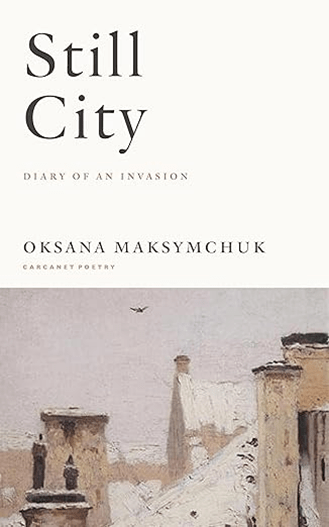
More than a hundred years later, the cover of Still City, featuring snow-laden roofs against a white sky and a drone-like bird frozen mid-air suggests in the same manner the looming Homeric “white ruin” of war under the false serenity of snow. It also materializes the force lines that shape the collection (and perhaps war poetry in general) – namely the symbolic and formal dialectic between stillness and movement, expansion and concentration, abstraction and figuration…
Continue reading the review here

Military Mental Health in the Ukraine-Russia War. Interview with Capt. Oleh Hukovskyy (MD) of the Ukrainian Armed Forces

By Edward Tick and Gianluca Cinelli

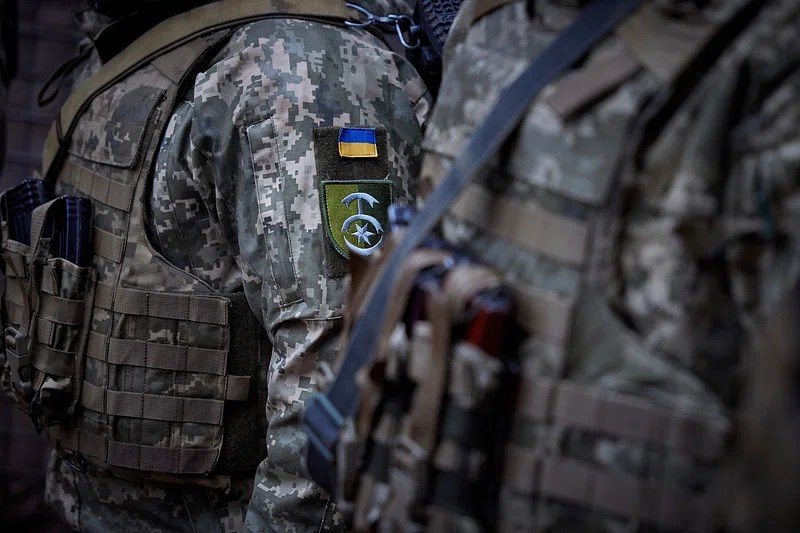
Ukrainian troops. Public domain

Since 24th February 2022, Ukraine has been fighting for its independence and survival as a free nation. However, the conflict with Russia had already begun years before with the Russian annexation of the Crimean Peninsula in 2013. The war has so far caused immense devastation and loss in Ukraine. Dr Edward Tick and Dr Gianluca Cinelli conducted an interview with the Chief of Combat Stress Control Group Capt. Oleh Hukovskyy on 9th May 2024. The interview touches upon topics such as the treatment of psychological stress and trauma among the Ukrainian troops and the importance of this support for combat personnel on the frontline and immediately behind the lines. By publishing this interview, the Editorial Team of the Close Encounters in War Journal express their solidarity with the people of Ukraine and hope to see the war’s end very soon.

Send me to the interview

“The Most Urgent of Dispatches”: One Language by Anastasia Taylor-Lind, Sheffield, Smith|Doorstop Books, 2022

By Sarah Montin

In his poem “Resistance”, written in March 2022, Simon Armitage draws on the collective memory of previous wars to comment on the recent Russian invasion in Ukraine. Quoting Philip Larkin’s celebrated “MXCXIV”, the Poet Laureate inscribes his response to the conflict in Ukraine in that eternal palimpsest that is war poetry:

It’s war again: a family
carries its family out of a pranged house
under a burning thatch.
The next scene smacks
of archive newsreel: platforms and trains
(never again, never again)

Read the full text here

A Short Guide to Successful Gardening in the Time of War

By Olga Kornyushyna, in loving memory of Andriy Romanov, killed in action April 26, 2024

Courtesy by Olga Kornyushyna©

Between the day we received Olga’s story and today, the gardening company in Odessa mentioned in the text was destroyed during the Russian air strike on May 1, 2024. Thousands of plants and trees were burned, warehouses and offices destroyed. Luckily there were no casualties among the employees. The owners of the company released a video of the aftermath of the attack. 

Read A Short Guide to Successful Gardening in the Time of War

A testimony from the Ukrainian front: “Crimes” by Ivan Choopa

Translated by Mariya Bahriy and Olga Kornyushyna

Ivan Choopa©

After each assault, the Russian occupiers would take a break from two to three days for pulling up the reserves, delivering more ammunition, and picking up their stiffs and wounded. The stiffs often remained unclaimed. The wounded would be picked up more often than not, but not on the regular basis.

If you caught this break, it was possible to daringly fuck around in the tree lines. The key was not to get too cheeky and keep out of the enemy’s line of sight. Or else.

Sometimes this moment of comfort came from our side as well. Then the silence was even scarier than hearing all those various bangs from both sides. On just such a day, we ventured into tree line number 18 with one aim only – to steal something…

Continue reading here

Issue n. 6 (2023) of the CEIWJ is online

We are delighted to announce that Issue n. 6 (2023), Close Encounters in War and Propaganda: The Battles for Hearts and Minds, is online.

Gino Boccasile (1901-1952) WWII Italian anti-American Fascist propaganda poster, 1943. Public domain image.

The full Issue and single contributions can be downloaded as PDF here:

Issue n. 6 (2023), Close Encounters in War and Propaganda: The Battles for Hearts and Minds

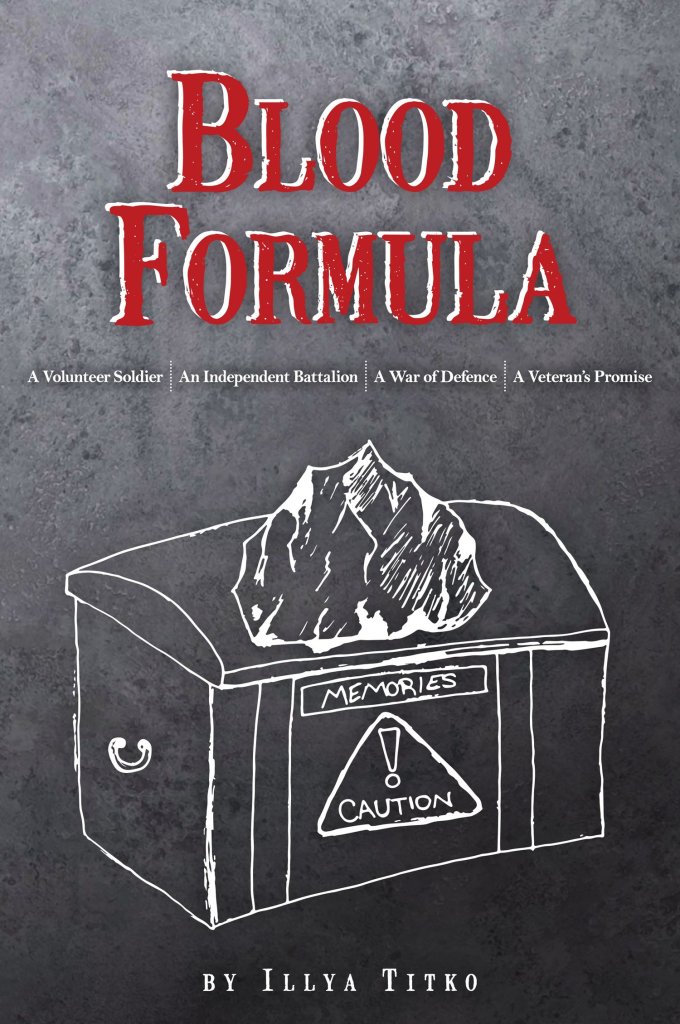
Book Review: Illya Titko, “Blood Formula”, translated by Jeffrey Stephaniuk, Regina, Benchmark Press, 2021, 210 p.

By Gianluca Cinelli

Senior Lieutenant Illya Titko is a combat veteran from Kalush, Ivano-Frankivsk Oblast, Ukraine. He was drafted in September 2015, or rather, he volunteered for the mobilization that was underway. Mr. Titko writes his book from the per­spective of a citizen-soldier, as a man who continued to maintain one foot firmly in the civilian world, even though his new environment was a war zone, and “war is when your entire world is turned upside down.”

Jeffrey Stephaniuk, the excellent translator of this book, introduces with these words the author (at p. 6), highlighting the perspective from which the whole story is told: that of a “citizen in arms”, a man who has answered the impellent call of duty when his country was in dire danger. Titko himself adds some remarks a few pages later:

It was not an easy task for me to write this book. It was a real inner struggle, for over a year, on whether I should write it or not. But I was pre-occupied with those past events, mulling that chaotic time over and over in my mind, conscious of the fact that it really wasn’t that long ago when I lived through them. There were nights when I couldn’t even sleep. I’d argue with myself: Should I or should I not write this book? I clearly understood that not only should I write this book, but it was nec­essary for this book be written. First, it was necessary so that everything I ex­perienced would have its place and not become lost in the subsequent living of my everyday life. I needed to write this book so that those who hadn’t been there personally could know about these events. I wanted them to know what happened and how they happened to those involved, with the people, with the country, and of course all those individuals who resolved to walk this same path, namely sol­diers defending their country. I realized that such a book would be necessary for children, grandchildren, and great grandchildren, so that they would have access to first-hand accounts about these difficult and stormy days and nights in the history of our nation. (12)

Read the review here

“Poems for Roman” by Svitlana Povalyaeva

Svitlana Povalyaeva is a Ukrainian writer and poet. She received a degree in journalism at the National Shevchenko University in Kyiv and worked as a journalist for a number of years at major TV channels and media outlets. Svitlana is the author of eight books, one of which is a collection of poetry “After Crimea” that was written after the annexation of Crimea. Her second poetry book will be published in Ukraine by the end of 2022. Over the years, Svitlana took part in countless major literary events, festivals and forums as an author, presenter, and speaker. She practices Buddhism, which has an important influence on her writing. Svitlana is a long-standing civil activist. She took an active part in the Revolution of Dignity (also known as Euromaidan) in Kyiv in 2013-2014 together with her two sons.

Her younger son Roman Ratunyi was a well-known Ukrainian public figure, a defender of green recreational zones of the city of Kyiv, an author of original forms of municipal activism and resistance to corruption, which went far beyond environmental issues, and a volunteer soldier. When the full-scale Russian invasion broke down on February 24, 2022, Roman enlisted as a volunteer and fought in the battle for Kyiv, he took part in the de-occupation of Kyiv Oblast and later joined the 93rd separate mechanized brigade of the Ukrainian Armed Forces “Kholodnyi Yar” where he was a part of the military intelligence unit. Roman took part in the liberation of the town of Trostyanets and fought in Sumy Oblast. He was killed in action near Izium, Kharkiv Oblast on June 8, 2022. The sentence written by Roman in his last will and testament is symbolic: “Kyiv, I died far from you, but I died for you”. Roman became an inspiration for thousands of Kyiv residents and a symbol of the young generation of Ukrainians.

Read the poems for Roman here