“Shared in Shards”:  Fragments from the War in Ukraine.

Review of Oksana Maksymchuk’s Still City, Diary of an Invasion

By Sarah Montin
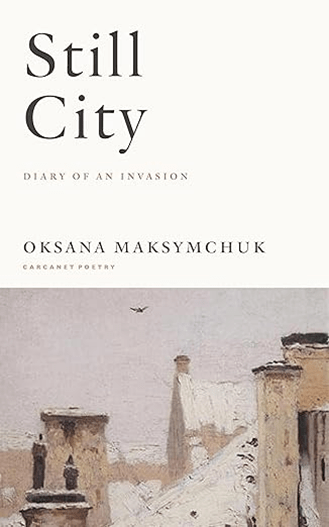
Are they there yet?” is the question haunting Oksana Maksymchuk’s debut collection in English which chronicles the period just before and after Russia’s invasion of Ukraine in February 2022. Exiled in the US since the 1990’s, author of two poetry collections in Ukrainian and the celebrated co-translator of Apricots of Donbas by Lyuba Yakimchuk and The Voices of Babyn Yar by Marianna Kiyanovska, Oksana Maksymchuk returned to her hometown of Lviv just before Russia launched its “special operation” on 24th February 2022. Poised for war, Maksymchuk’s poetic Diary of an Invasion is frozen in the expectation of violence, hushed in the anxiogenic stillness of “things to come/waiting to be unwrapped” (When a Missile Finds a Home).

“Snow is a strange white word” wrote British war poet Isaac Rosenberg as he learned of Great Britain’s entrance in the war in August 1914 and witnessed the winter of the world closing in: “Ice and frost and snow / From earth to sky / This summer land does know / No man knows why” (On Receiving the First News of the War).

More than a hundred years later, the cover of Still City, featuring snow-laden roofs against a white sky and a drone-like bird frozen mid-air suggests in the same manner the looming Homeric “white ruin” of war under the false serenity of snow. It also materializes the force lines that shape the collection (and perhaps war poetry in general) – namely the symbolic and formal dialectic between stillness and movement, expansion and concentration, abstraction and figuration…

Continue reading the review here

The Legacy of the Vietnam War in a Poem: “Market Day” by Karly Randolph Pitman

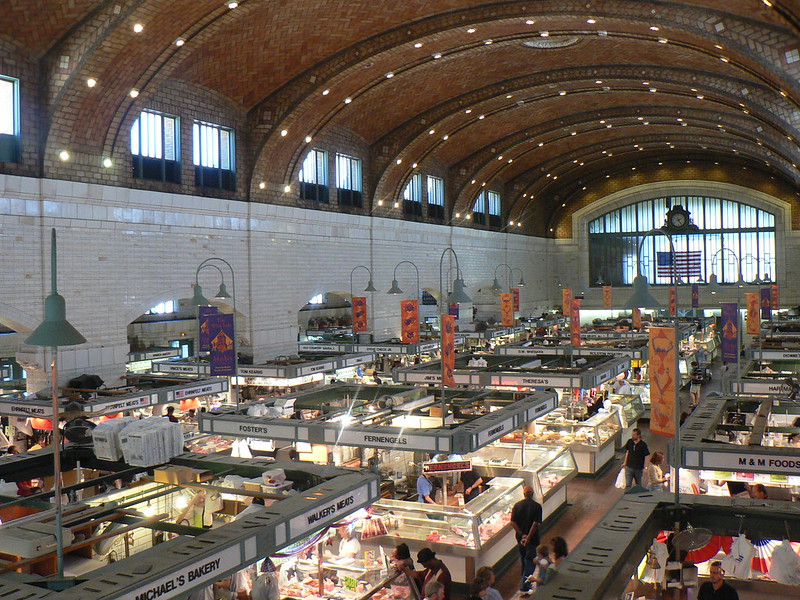
When I visit my parents in the Cleveland suburbs, my 81-year-old father and I go to the West Side Market. The market is a Cleveland landmark, and has served produce, meats, bakery items, and prepared foods in an old, beautiful brick building for over a hundred years.

My dad goes to the market every week to pick up his beef, a loaf of wheat bread, and a treat or two – shrimp dip, gyro sandwiches, or apple strudel. He wears his “Vietnam Vet” baseball hat and people come up to thank him for his service – a strong contrast to his experience coming home from the war in 1970.

I’d long wanted to honor my dad and his war experience by writing a poem about our market trips. Then a few years ago, I worked with a therapist who asked me a surprising question – “Did you know you carry your dad’s fear from the war in your nervous system?” That left me weeping in the truth of it, and in relief. And it left me wondering what I could do to help ease our pain…

Read the full story and Market Day poem here

Karly Randolph Pitman is a writer, teacher, poet, presenter, and mental health facilitator who helps people nurture a more compassionate relationship with their struggles. She creates books, courses, presentations and trainings to bring insight to our human vulnerabilities, especially food suffering like overeating. In addition to her healing work, Karly is a published poet, writes a reader supported poetry newsletter, O Nobly Born, offers writing and mindfulness workshops to nurture self-awareness and self-compassion, and works with teens as a teacher and tutor. She lives in Austin, Texas with her family where she takes her sweet dog on leisurely bike rides and creates as much as possible with her hands. In all she remains in awe of the human heart.

Book Review: “From War Archives to War Poetry”. Taking Mesopotamia by Jenny Lewis, Oxford Poets/Carcanet, 2014

By Sarah Montin

Jenny Lewis’ captivating collection of war poems, published in 2014, on the centenary of the First World War, appears even more relevant today as Europe finds itself once more engaged in armed conflict.

“My father died when I was few months old and I have been searching for him ever since announces the poet in her preface (Lewis 2014a, 11), presenting her collection as a voyage into her father’s military service in the First World War, initiated by her timely discovery of “a dusty old suitcase” full of “faded papers and memorabilia” in her basement at Oxford (Lewis 2014b). Fruit of extensive research at the National Archives and the Imperial War Museum – six years looking into her father’s service as a Second Lieutenant in the 4th Battalion of the South Wales Borderers – and supplemented by interviews of contemporary soldiers and war victims, Taking Mesopotamia offers a persuasive reflexion on the experience of war from the perspective of combatants and civilians alike. Fostering parallels between the British Mesopotamian Campaign of the Great War (1914-1918), the war in Iraq (2003-2011), and the 4000-year-old Sumerian Epic of Gilgamesh, Jenny Lewis offers a multi-layered reflection on the timeless themes of war and man’s hubris, alluded to in the book’s epigraph: “As for humans, their days are numbered/Whatever they do is like a puff of wind” (Gilgamesh, Tablet III)…

Read the full text here

Book Review: John Zilcosky, “The Language of Trauma. War and Technology in Hoffmann, Freud, and Kafka”, Toronto, University of Toronto Press, 2021, 174 p.

By Stefano Bellin

The concept of trauma holds a prominent position both in the Humanities and in the Behavioural Sciences. It is simultaneously invoked in a variety of contexts and contested for its fuzziness, Western/Eurocentric pedigree, and sociocultural implications. Given the wide currency that the discourse of trauma has acquired, a study that investigates the roots of the concept and its connection to language, war, and technology is a very welcome addition to the scholarship on modernity. Indeed, as Michael Rothberg writes in the preface of The Future of Trauma Theory: Contemporary Literary and Cultural Criticism, “thinking genealogically about trauma is one essential means of opening it towards possible, alternative futures” (Rothberg 2013, xi). John Zilcosky’s The Language of Trauma is a brilliant case in point. The first, more noticeable, goal of the book is to shed light on the relationship between trauma and modernity. Zilcosky focuses on the experiences of war, bombing, and early railway journeys – three phenomena that bring to the fore the violence of modern warfare and bureaucratic-mechanised work. The study concentrates on Germanophone literature, taking E.T.A. Hoffmann’s The Sandman, Sigmund Freud’s The Uncanny, and Franz Kafka’s The Metamorphosis as primary examples. These close readings allow Zilcosky to historicise trauma and dissect its aporias, in particular, the difficulty of having one’s trauma recognised – a difficulty that often generates a short circuit, a trauma that grows out of the very slipperiness of trauma and the indeterminacy of its epistemological and ontological status. The second, thought-provoking, goal of the book “is to connect this medical language of trauma with the language of scepticism in romanticism and modernism, specifically, through the two discourses’ obsession with inscrutability” (p. 6).

Read the full text here

“Poems for Roman” by Svitlana Povalyaeva

Svitlana Povalyaeva is a Ukrainian writer and poet. She received a degree in journalism at the National Shevchenko University in Kyiv and worked as a journalist for a number of years at major TV channels and media outlets. Svitlana is the author of eight books, one of which is a collection of poetry “After Crimea” that was written after the annexation of Crimea. Her second poetry book will be published in Ukraine by the end of 2022. Over the years, Svitlana took part in countless major literary events, festivals and forums as an author, presenter, and speaker. She practices Buddhism, which has an important influence on her writing. Svitlana is a long-standing civil activist. She took an active part in the Revolution of Dignity (also known as Euromaidan) in Kyiv in 2013-2014 together with her two sons.

Her younger son Roman Ratunyi was a well-known Ukrainian public figure, a defender of green recreational zones of the city of Kyiv, an author of original forms of municipal activism and resistance to corruption, which went far beyond environmental issues, and a volunteer soldier. When the full-scale Russian invasion broke down on February 24, 2022, Roman enlisted as a volunteer and fought in the battle for Kyiv, he took part in the de-occupation of Kyiv Oblast and later joined the 93rd separate mechanized brigade of the Ukrainian Armed Forces “Kholodnyi Yar” where he was a part of the military intelligence unit. Roman took part in the liberation of the town of Trostyanets and fought in Sumy Oblast. He was killed in action near Izium, Kharkiv Oblast on June 8, 2022. The sentence written by Roman in his last will and testament is symbolic: “Kyiv, I died far from you, but I died for you”. Roman became an inspiration for thousands of Kyiv residents and a symbol of the young generation of Ukrainians.

Read the poems for Roman here

“The Emotions after War in Viet Nam. Poetry from my Reconciliation and Healing Journeys”, by Edward Tick

Seeking the most comprehensive and holistic healing of war wounds possible, I have been leading annual reconciliation journeys to Viet Nam for veterans and other war survivors every year since the twenty-fifth anniversary of the end of the war in 2000. Encounters between survivors of all sides squeeze long-ago memories and feelings out of American and Vietnamese alike. Through poetry I record the voices and stories of women and men who lived through extraordinarily close encounters during war and again on meeting today. These encounters show the depths and complexities of our emotional lives during times of warfare and its aftermath when we can transform fear and hatred into understanding, compassion and love.

Read Ed’s poems here

Dòng suối quê hương (The Streams of Our Native Land): a poem by Trần Đình Song

Dear readers of Close Encounters in War, we are delighted to publish another poetic contribution about the Vietnam war, this time from the perspective of a Vietnamese veteran: Trần Đình Song, who served in the Southern Vietnamese Air Force and was in the re-education forced labour camps after the war. This beautiful poem was written in 1966, and although the horror of civil war war haunted the Author and his country, his words are full of love and hope. We publish the poem in its original version, accompanied by the new English translation that the Author made with his friend and member of the CEIWJ Editorial Board Edward Tick.

Dòng suối quê hương (The Streams of Our Native Land), by Trần Đình Song

Close Encounters in War launches a new section for stories and poetry

Stories and poems of close encounters in war

Close encounters in war are, before anything else, life experiences that change in depth those who make them. As editors of the Close Encounters in War Journal, we have always been aware of this simple but basic fact and therefore decided to open the third issue of the journal (2020) to creative writing. We wanted to propose an experimental encounter between scholarly research and forms of creative and non-fictional writing whose roots go deep into experience and imagination.

After that exciting experience, being aware that stories and poems of close encounters in war deserve a place of their own in the website, we are happy to announce the launch of the new section “Stories and poems of close encounters in war“.

This new section of the journal is divided into three subsections (Poetry, Fiction, and Testimonies and Autobiographical Essays) and is meant to be a space for creativity and exploration of all those forms of writing that help us understand war more thoroughly as a multifaceted and complex experience. We invite storytellers, veterans, practitioners, relatives and friends of veterans, poets, therapists, and much more to feel free to submit their contributions to the CEIWJ. We will be happy and grateful to read year round your original and unpublished works about your encounters in and with war, real and imagined. We will select and publish the best, more insightful, and inspiring contributions.