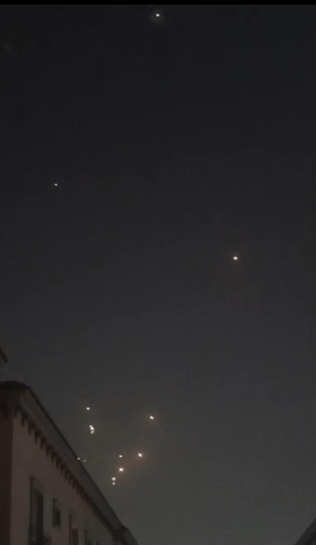
Rockets in the night sky in a picture taken by the author
It happened again. Less than a year later, I stood in the exact same spot and counted, through the window, the orange lights moving steadily toward me. They streaked across the sky with terrifying purpose. It is almost ironic that I grew up in a country ravaged by civil war for three decades and never once heard the sound of a bomb, yet here I was, feeling the walls tremble around me. The attempt to flee felt laughable from the very beginning.
All we could do was grip our packed bags and stand on the doorstep, praying to every god we knew that the orange lights slicing through the sky would not fall on us…
Take me out of here! This pin gun flare behind your ear will blow your nose from this end. Drive asshole! Now, that we are clear of your black pajama cowboy boyfriends, let’s get real. You were setting me up.
Take me to the address on the paper I gave you. You wanted those cowboys to kill me and take my money. Well, asshole you picked the wrong guy. Now take me to that address or I will blow your head off and steal your taxi. I’m staying in Saigon tonight.
I remember getting out of the cab with pounding in my chest. Fearful and pumped. I was trying to meet up with my special bar girl. Her name is Mya, or at least that is what I call her at the bar. She takes good care of me. The bar girls are our main source of bought affection. Mya is my favorite. She is older, maybe twenty-eight. She supplies affection and tending for money. All the bar girls smell good and flirt with us. When you are thousands of miles from round eyed girls your age, Vietnamese bar girls are very desirable. They are in the war also. They sell their bodies for money to survive. Women have few legit jobs in the city. They make their money off G.I.s. that get time off and can get into Saigon. American CIA and government officials do not indulge in bar girls. They are big time. Most have a Vietnamese girl friend that they maintain in high style. I bet they do not write home about those arrangements…
In the wake of recent studies about Italian participation in the Second World War, this volume fills a gap in historical knowledge by focusing on sources that have been neglected or at least not investigated thoroughly and systematically. These sources are diaries that Italian citizens with different social, professional and geographical backgrounds wrote between 25 July 1943 and the end of the war in the spring of 1945. The author analysed 90 diaries (out of 150 consulted) collected at the Archivio della scrittura popolare in Trento, the Archivio diaristico nazionale in Pieve Santo Stefano, and the Archivio Ligure della scrittura popolare in Genoa. The author chose to focus her investigation on diaries because “in a situation characterized by institutional uncertainties and historical unknowns, such as the one Italy faced between 1943 and 1945, feelings of incongruousness and confusion unsettled people’s usual understandings and disrupted their conventional patterns of interpretation and action” (p. 6). Therefore, the day-to-day practice of diary-writing permits her to observe the “ordinary” as it varies across generation, class, and gender and see through these “marginalised narratives” how “people’s interpretation of historical events from the standpoint of their everyday experience affected their responses to those same events and created new political sensibilities” (p. 28). To do that, the author refers to Raymond William’s analytical tool known as “structures of feeling”, a formula cast to convey the idea of the “felt sense of the quality of life” at a particular historical time (p. 4)…
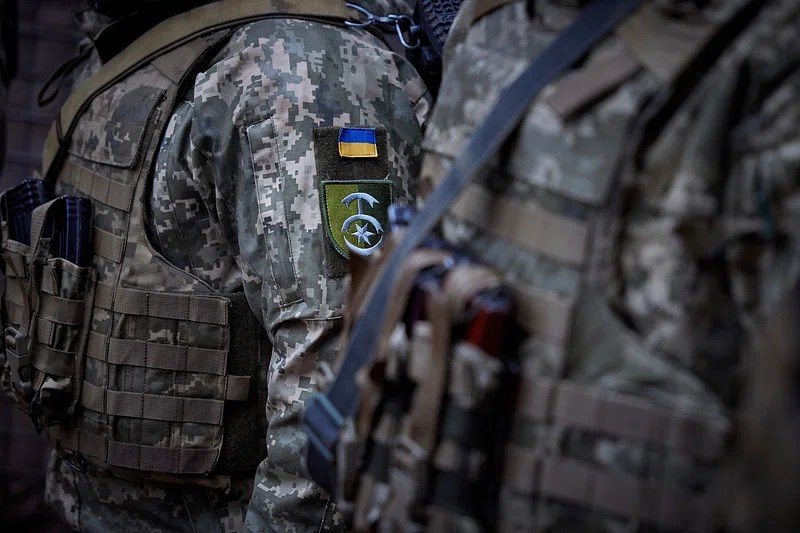
Since 24th February 2022, Ukraine has been fighting for its independence and survival as a free nation. However, the conflict with Russia had already begun years before with the Russian annexation of the Crimean Peninsula in 2013. The war has so far caused immense devastation and loss in Ukraine. Dr Edward Tick and Dr Gianluca Cinelli conducted an interview with the Chief of Combat Stress Control Group Capt. Oleh Hukovskyy on 9th May 2024. The interview touches upon topics such as the treatment of psychological stress and trauma among the Ukrainian troops and the importance of this support for combat personnel on the frontline and immediately behind the lines. By publishing this interview, the Editorial Team of the Close Encounters in War Journal express their solidarity with the people of Ukraine and hope to see the war’s end very soon.
A Yiddish proverb, as Auschwitz survivor Primo Levi recalls, says that it’s good to talk about bygone troubles. However, Yiddish culture can be profoundly ironic, and Primo Levi mastered the subtle art of understating. Troubles that one can tell belong in the past, yet they still linger on in the present as memories. Talking about bygone troubles is good because it means we saw them through. However, it does not mean that it is pleasant or easy. It takes courage and strength to face nightmarish and painful memories. Many of us remember the Ancient Mariner, who feels the compelling urge to stop people down the street and keep them listening to his guilt-ridden story full of horrors and fear. He acts like a madman, roaming the streets like an outcast, for he lives stuck in his haunting past and never finds his way back into society. The Ancient Mariner feels he must atone for his guilt of having killed the innocent albatross and survived in the place of his comrades, who died because of his hubris. Split as he is between past and present, the Ancient Mariner is no longer whole.
Talking about haunting memories is hard but necessary to lift their evil spell, as Edward Tick writes in the Foreword to this book by David T. Klein: “Warriors have their horrific ordeals and need their stories. Story is critical to warrior healing and restoration. To restore the warrior’s spirit, we must support her or him in ‘re-storying’. To disallow storytelling, as well-intentioned brief therapies do, is to betray the warrior by blocking necessary steps in their healing and homecoming” (p. 2).
We are delighted to announce the publication of the seventh Issue of the CEIWJ for 2024, devoted to the topic “Close Encounters in War and Personal Narratives: Experience, Memory, and Storytelling”.
The full Issue and single articles can be read online or downloaded from the
I am a non-combat veteran who served in the American Air Force during the last few years of the Cold War in an atmosphere that was witnessing the “defeat” of the Soviet Union and the spread of democracy in Eastern Europe. I served at Vanderburg Air Force Base in Lompoc, California (now Space Forces Base), which test-launched nuclear ballistic missile systems. These tests were a simulation of what a typical missile launch would look like if completed in the field. That is, if the U.S. were to launch our nuclear weapons from an operational missile base.
A maintenance and logistical group prepared the launch facility for operational readiness to be launched by the missile crew. I was part of this extensive maintenance and logistical group. So, where was the combat zone? Where was mine? I suggest that the “combat zone” is not always out of the country and not necessarily in armed conflict but is determined by the organization and circumstances. In my case, it was Vandenberg Air Force Base where I was in direct contact with the test launching of the Minute Man III nuclear weapons system. This system was designed to destroy large cities and enemy bases, basically rendering the enemy no means of deploying their forces. However, when a nuclear weapon is launched, there will be no one left to govern nations or deploy any troops. So, was I in a combat situation? What about other supposed non-combatants who are exposed to combat dangers or consequences? What about those members of the military who have direct contact with deploying military troops to a combat zone or those who must receive the deceased troops? Where is their “combat zone?”
“War Diary: The Diary of Mike Rogers” is a compelling personal narrative that offers an intimate glimpse into the life and experiences of Michael John Warrington Rogers during World War II. Spanning from the outbreak of WW2 in 1939, to the end of 1945 and the dropping of the atomic bombs, War Diary: The Diary of Mike Rogers entries chronicle the daily realities of war, from the grand strategic movements of the Allied forces to the personal struggles and moments of respite that defined his existence.
Through Mike Rogers’ eyes, readers are transported to the front lines of pivotal events such as the Dunkirk Evacuations, The Blitz and later in the War, the Battle of Normandy, the liberation of Paris, and the harrowing Battle of the Bulge. His reflections on the relentless V2 bombings and the bold, albeit ultimately unsuccessful, German Operations provide a vivid account of the war’s impact on civilians.
The accompanying website, www.wardiaryonline.com, serves as a digital archive and interactive platform where readers can explore additional content, including photographs, historical documents, and detailed maps. The website also invites contributions from those with connections to the events described, enriching the narrative with personal stories and memorabilia.
“War Diary: The Diary of Mike Rogers” is more than just a historical document; it is a testament to the resilience and determination of individuals facing extraordinary circumstances. Through Mike Rogers’ detailed and poignant entries, “War Diary: The Diary of Mike Rogers” offers a powerful and personal perspective on World War II, making it an essential addition to the study of personal narratives in wartime history.
“War Diary: The Diary of Mike Rogers” stands out for its raw, unfiltered portrayal of wartime life. The War Diary: The Diary of Mike Rogers project not only preserves the legacy of those who lived through these tumultuous times but also provides invaluable insights into the human condition under the pressures of war.
The Legacy of the Second World War in the Memory of the Third Generation
Liberation of Bologna, April 1945 (Wikimedia – public domain)
We would like to share here with our readers the news about the launch of the MemoGen website.
MemoGen is a Oral History project aimed at collecting video interviews with people born in Italian families between the 1960s and the 1980s. The topic of the interviews is the legacy of the Second World War in Italian culture and society between 1945 and today.
Between the day we received Olga’s story and today, the gardening company in Odessa mentioned in the text was destroyed during the Russian air strike on May 1, 2024. Thousands of plants and trees were burned, warehouses and offices destroyed. Luckily there were no casualties among the employees. The owners of the company released a video of the aftermath of the attack.



 Close Encounters in War