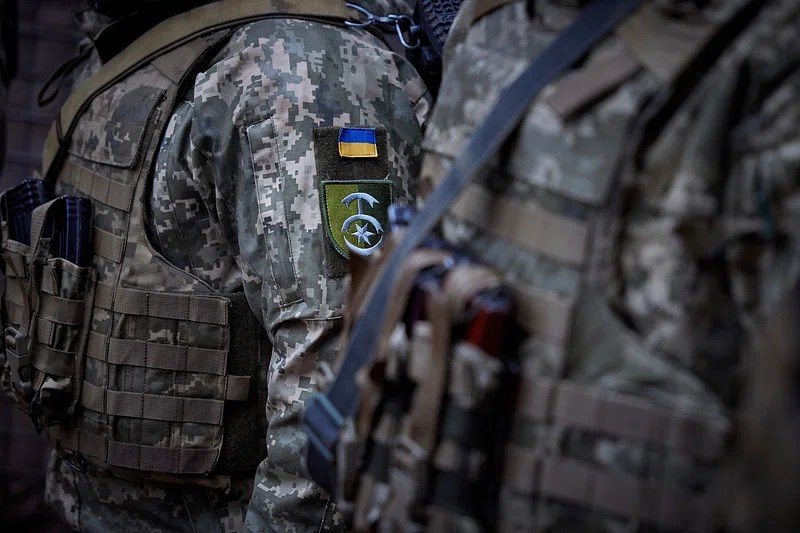
Since 24th February 2022, Ukraine has been fighting for its independence and survival as a free nation. However, the conflict with Russia had already begun years before with the Russian annexation of the Crimean Peninsula in 2013. The war has so far caused immense devastation and loss in Ukraine. Dr Edward Tick and Dr Gianluca Cinelli conducted an interview with the Chief of Combat Stress Control Group Capt. Oleh Hukovskyy on 9th May 2024. The interview touches upon topics such as the treatment of psychological stress and trauma among the Ukrainian troops and the importance of this support for combat personnel on the frontline and immediately behind the lines. By publishing this interview, the Editorial Team of the Close Encounters in War Journal express their solidarity with the people of Ukraine and hope to see the war’s end very soon.
Private Thayer Greene had just turned 19 when he entered the city of Nordhausen as his regiment’s lead scout. It was 11th April 1945. He had already experienced the terror of enemy soldiers shooting at him, and on this day he would witness the horror of mass murder.
He expected to get machine-gunned at any moment. As he carefully entered the city, he saw a man coming toward him in a uniform he didn’t recognize. He raised his rifle, but lowered it after seeing no weapon. The man, a walking skeleton, approached, fell to his knees and kissed Greene’s feet. “Freiheit! Freiheit! Freiheit!” he cried. That’s German for “Freedom!”
Greene had stumbled on the site of a concentration camp that had been abandoned by German soldiers as the Allies advanced. At the time, American soldiers knew nothing about the camps that the Nazis had created all over Europe. When he died in 2022 at the age of 95, Thayer Greene was one of the last living liberators of concentration camps. When his fellow soldiers entered the camp at Nordhausen in central Germany, they encountered an estimated 1,300 bodies of prisoners who had been shot or starved to death…
A Yiddish proverb, as Auschwitz survivor Primo Levi recalls, says that it’s good to talk about bygone troubles. However, Yiddish culture can be profoundly ironic, and Primo Levi mastered the subtle art of understating. Troubles that one can tell belong in the past, yet they still linger on in the present as memories. Talking about bygone troubles is good because it means we saw them through. However, it does not mean that it is pleasant or easy. It takes courage and strength to face nightmarish and painful memories. Many of us remember the Ancient Mariner, who feels the compelling urge to stop people down the street and keep them listening to his guilt-ridden story full of horrors and fear. He acts like a madman, roaming the streets like an outcast, for he lives stuck in his haunting past and never finds his way back into society. The Ancient Mariner feels he must atone for his guilt of having killed the innocent albatross and survived in the place of his comrades, who died because of his hubris. Split as he is between past and present, the Ancient Mariner is no longer whole.
Talking about haunting memories is hard but necessary to lift their evil spell, as Edward Tick writes in the Foreword to this book by David T. Klein: “Warriors have their horrific ordeals and need their stories. Story is critical to warrior healing and restoration. To restore the warrior’s spirit, we must support her or him in ‘re-storying’. To disallow storytelling, as well-intentioned brief therapies do, is to betray the warrior by blocking necessary steps in their healing and homecoming” (p. 2).
2010 is when I began to become a veteran. It was more than 40 years after I had returned to the United States from Viet Nam. Forty years of madness, nightmares, drug abuse, suicide attempts. 2010 is when I began to speak about it. And write about it. And cry. 40 years of tears coming out all at once. I am still becoming a vet. My first piece of writing as I started to embrace my identity as a veteran, that I share here, was an open letter to my brothers and sisters of the wars in Afghanistan and Iraq. Though the numbers given derive from the original writing in 2010, my message and warning are still relevant to any warriors from any country and war struggling to return home after experiencing the horrors of combat and many difficulties of return.
Lawrence Markworth served in the US Navy between 1962 and 1966 and participated in the Vietnam War on the USS Castor. After struggling for decades with his traumatic memories, he eventually reconnected with his younger self, who had gone through the ordeal of war. We publish here a short autobiographical testimony of Lawrence’s journey, which was extracted from his forthcoming memoir Rowing through a Sea of Rubble.
“This is too much! It seems like I just get over one crisis and another occurs. I need to piece my soul together.” So blurted author Sieu Sean Do’s mother after the family’s harrowing and narrow escape into Viet Nam from the Khmer Rouge genocide in their native Cambodia. Sieu Sean’s memoir of the family’s journey from an idyllic childhood in rural Cambodia through the hell of the Killing Fields is his work through witnessing and storytelling to piece his soul together.
Sieu’s narrative of the family’s long ordeal is largely straightforward. He was a child and teenager during these ordeals, so we see them through the innocent boy’s eyes. The narrative piles incident upon incident as challenges, crises, betrayals, disappointments, abandonments, starvation, crimes, executions, and accidental deaths cascade not only upon this family, but all of Cambodia. Yet the story takes us to Cambodian traditions and intimately into his large extended family that, miraculously, survived together. As he summarizes at the end, “Our elders taught us well that we need to survive not just alone, but together.” Thus, as readers we have close encounters not just with the horrors of genocide, but the intimacies of a traditional Cambodian family and many traditional practices and folk tales that surround and support the survivors in their ordeals.
The concept of trauma holds a prominent position both in the Humanities and in the Behavioural Sciences. It is simultaneously invoked in a variety of contexts and contested for its fuzziness, Western/Eurocentric pedigree, and sociocultural implications. Given the wide currency that the discourse of trauma has acquired, a study that investigates the roots of the concept and its connection to language, war, and technology is a very welcome addition to the scholarship on modernity. Indeed, as Michael Rothberg writes in the preface of The Future of Trauma Theory: Contemporary Literary and Cultural Criticism, “thinking genealogically about trauma is one essential means of opening it towards possible, alternative futures” (Rothberg 2013, xi). John Zilcosky’s The Language of Trauma is a brilliant case in point. The first, more noticeable, goal of the book is to shed light on the relationship between trauma and modernity. Zilcosky focuses on the experiences of war, bombing, and early railway journeys – three phenomena that bring to the fore the violence of modern warfare and bureaucratic-mechanised work. The study concentrates on Germanophone literature, taking E.T.A. Hoffmann’s The Sandman, Sigmund Freud’s The Uncanny, and Franz Kafka’s The Metamorphosis as primary examples. These close readings allow Zilcosky to historicise trauma and dissect its aporias, in particular, the difficulty of having one’s trauma recognised – a difficulty that often generates a short circuit, a trauma that grows out of the very slipperiness of trauma and the indeterminacy of its epistemological and ontological status. The second, thought-provoking, goal of the book “is to connect this medical language of trauma with the language of scepticism in romanticism and modernism, specifically, through the two discourses’ obsession with inscrutability” (p. 6).
War affects our world and lives, whether we are directly involved or not. Its effects are like those of a disease that spreads through the organism, weakening it and altering its relationship with the environment. War destroys communities, poisons associated life, and builds walls. And, which is worse, it plants rotten seeds from which bitter fruits will grow. One antidote to the spread of its malice is listening to the stories of those who have seen its very Gorgon’s face and suffered from its scorching touch.
The Close Encounters in War Journal inaugurates a new section called Back to the light. Stories of healing from trauma. It is entirely devoted to the stories of people who have experienced the war and learned how to cope with the burden of its traumatic memories. Sharing these stories means much to the authors both in terms of ethical commitment and psychological effort. They reveal something intimate that has been troubling them, a core of traumatic memories that haunt their lives. Nonetheless, they are eager to share their stories worldwide with a public of interested and empathic readers, who want to listen and know what war is about.
We are happy to launch this project with two contributions by Ukrainian refugee Olga Kornyushyna and American former infantryman Charles Collins. Olga tells about her traumatic encounter with war as a civilian who had to flee from Kyiv, bombed by the Russians in the present war. Charles tells how he went through four turns of deployment overseas and how he had to fight to heal the moral wounds that such experiences inflicted on him.
The editors of the CEIWJ would like to express their profound gratitude to the authors of these stories and invite all who have stories of healing from war trauma to share them with us and our readers. Veterans, families, friends, therapists, and healers are welcome to submit their contributions.
Our gratitude also goes to Ed Tick, who has generously accepted to embark on this endeavour as co-editor of the Back to the light project, and the members of the section-specific editorial board, Charles Aishi Blocher, Kate Dahlstedt, Nathan Graeser, Lawrence Markworth, Donald McCasland, Glen Miller, Roxy Runyan, and Floyd Striegel.