“Shared in Shards”:  Fragments from the War in Ukraine.

Review of Oksana Maksymchuk’s Still City, Diary of an Invasion

By Sarah Montin
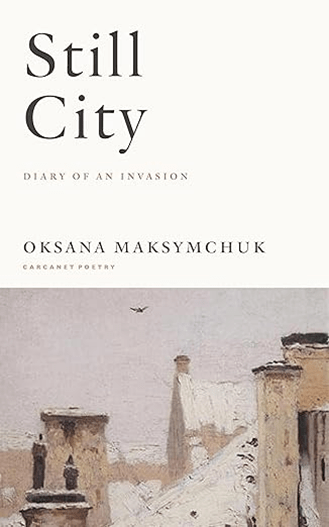
Are they there yet?” is the question haunting Oksana Maksymchuk’s debut collection in English which chronicles the period just before and after Russia’s invasion of Ukraine in February 2022. Exiled in the US since the 1990’s, author of two poetry collections in Ukrainian and the celebrated co-translator of Apricots of Donbas by Lyuba Yakimchuk and The Voices of Babyn Yar by Marianna Kiyanovska, Oksana Maksymchuk returned to her hometown of Lviv just before Russia launched its “special operation” on 24th February 2022. Poised for war, Maksymchuk’s poetic Diary of an Invasion is frozen in the expectation of violence, hushed in the anxiogenic stillness of “things to come/waiting to be unwrapped” (When a Missile Finds a Home).

“Snow is a strange white word” wrote British war poet Isaac Rosenberg as he learned of Great Britain’s entrance in the war in August 1914 and witnessed the winter of the world closing in: “Ice and frost and snow / From earth to sky / This summer land does know / No man knows why” (On Receiving the First News of the War).

More than a hundred years later, the cover of Still City, featuring snow-laden roofs against a white sky and a drone-like bird frozen mid-air suggests in the same manner the looming Homeric “white ruin” of war under the false serenity of snow. It also materializes the force lines that shape the collection (and perhaps war poetry in general) – namely the symbolic and formal dialectic between stillness and movement, expansion and concentration, abstraction and figuration…

Continue reading the review here

Book Review: “From War Archives to War Poetry”. Taking Mesopotamia by Jenny Lewis, Oxford Poets/Carcanet, 2014

By Sarah Montin

Jenny Lewis’ captivating collection of war poems, published in 2014, on the centenary of the First World War, appears even more relevant today as Europe finds itself once more engaged in armed conflict.

“My father died when I was few months old and I have been searching for him ever since announces the poet in her preface (Lewis 2014a, 11), presenting her collection as a voyage into her father’s military service in the First World War, initiated by her timely discovery of “a dusty old suitcase” full of “faded papers and memorabilia” in her basement at Oxford (Lewis 2014b). Fruit of extensive research at the National Archives and the Imperial War Museum – six years looking into her father’s service as a Second Lieutenant in the 4th Battalion of the South Wales Borderers – and supplemented by interviews of contemporary soldiers and war victims, Taking Mesopotamia offers a persuasive reflexion on the experience of war from the perspective of combatants and civilians alike. Fostering parallels between the British Mesopotamian Campaign of the Great War (1914-1918), the war in Iraq (2003-2011), and the 4000-year-old Sumerian Epic of Gilgamesh, Jenny Lewis offers a multi-layered reflection on the timeless themes of war and man’s hubris, alluded to in the book’s epigraph: “As for humans, their days are numbered/Whatever they do is like a puff of wind” (Gilgamesh, Tablet III)…

Read the full text here

“The Most Urgent of Dispatches”: One Language by Anastasia Taylor-Lind, Sheffield, Smith|Doorstop Books, 2022

By Sarah Montin

In his poem “Resistance”, written in March 2022, Simon Armitage draws on the collective memory of previous wars to comment on the recent Russian invasion in Ukraine. Quoting Philip Larkin’s celebrated “MXCXIV”, the Poet Laureate inscribes his response to the conflict in Ukraine in that eternal palimpsest that is war poetry:

It’s war again: a family
carries its family out of a pranged house
under a burning thatch.
The next scene smacks
of archive newsreel: platforms and trains
(never again, never again)

Read the full text here