The Legacy of the Vietnam War in a Poem: “Market Day” by Karly Randolph Pitman

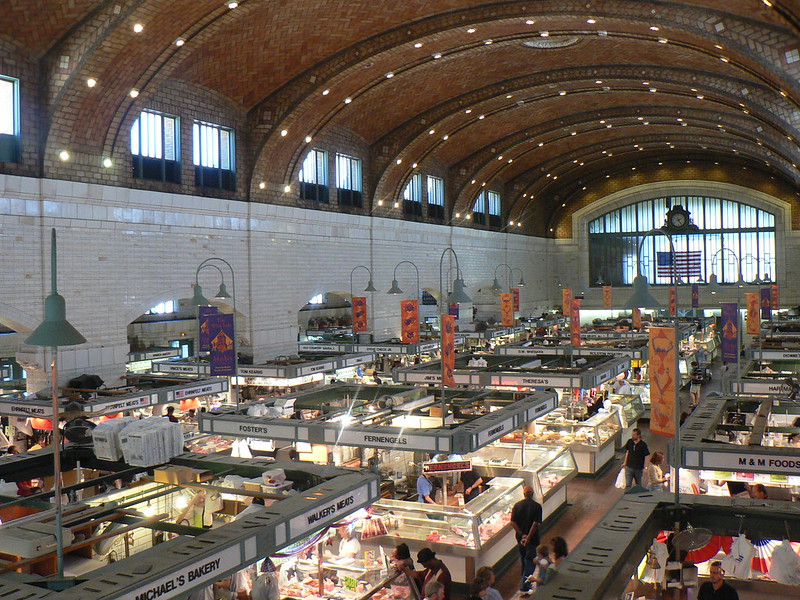
When I visit my parents in the Cleveland suburbs, my 81-year-old father and I go to the West Side Market. The market is a Cleveland landmark, and has served produce, meats, bakery items, and prepared foods in an old, beautiful brick building for over a hundred years.

My dad goes to the market every week to pick up his beef, a loaf of wheat bread, and a treat or two – shrimp dip, gyro sandwiches, or apple strudel. He wears his “Vietnam Vet” baseball hat and people come up to thank him for his service – a strong contrast to his experience coming home from the war in 1970.

I’d long wanted to honor my dad and his war experience by writing a poem about our market trips. Then a few years ago, I worked with a therapist who asked me a surprising question – “Did you know you carry your dad’s fear from the war in your nervous system?” That left me weeping in the truth of it, and in relief. And it left me wondering what I could do to help ease our pain…

Read the full story and Market Day poem here

Karly Randolph Pitman is a writer, teacher, poet, presenter, and mental health facilitator who helps people nurture a more compassionate relationship with their struggles. She creates books, courses, presentations and trainings to bring insight to our human vulnerabilities, especially food suffering like overeating. In addition to her healing work, Karly is a published poet, writes a reader supported poetry newsletter, O Nobly Born, offers writing and mindfulness workshops to nurture self-awareness and self-compassion, and works with teens as a teacher and tutor. She lives in Austin, Texas with her family where she takes her sweet dog on leisurely bike rides and creates as much as possible with her hands. In all she remains in awe of the human heart.

“Overnight with Mya”, a story -as raw as war- by US Vietnam veteran “No Socks”

Take me out of here! This pin gun flare behind your ear will blow your nose from this end. Drive asshole! Now, that we are clear of your black pajama cowboy boyfriends, let’s get real. You were setting me up.

Take me to the address on the paper I gave you. You wanted those cowboys to kill me and take my money. Well, asshole you picked the wrong guy. Now take me to that address or I will blow your head off and steal your taxi. I’m staying in Saigon tonight.

I remember getting out of the cab with pounding in my chest. Fearful and pumped. I was trying to meet up with my special bar girl. Her name is Mya, or at least that is what I call her at the bar. She takes good care of me. The bar girls are our main source of bought affection. Mya is my favorite. She is older, maybe twenty-eight. She supplies affection and tending for money. All the bar girls smell good and flirt with us. When you are thousands of miles from round eyed girls your age, Vietnamese bar girls are very desirable. They are in the war also. They sell their bodies for money to survive. Women have few legit jobs in the city. They make their money off G.I.s. that get time off and can get into Saigon. American CIA and government officials do not indulge in bar girls. They are big time. Most have a Vietnamese girl friend that they maintain in high style. I bet they do not write home about those arrangements…

Read the story here

Book Review: “A Veteran’s Toughest Fight. Finding Peace After Vietnam”, by David T. Klein, Jefferson, McFarland, 2024

By Gianluca Cinelli

A Yiddish proverb, as Auschwitz survivor Primo Levi recalls, says that it’s good to talk about bygone troubles. However, Yiddish culture can be profoundly ironic, and Primo Levi mastered the subtle art of understating. Troubles that one can tell belong in the past, yet they still linger on in the present as memories. Talking about bygone troubles is good because it means we saw them through. However, it does not mean that it is pleasant or easy. It takes courage and strength to face nightmarish and painful memories. Many of us remember the Ancient Mariner, who feels the compelling urge to stop people down the street and keep them listening to his guilt-ridden story full of horrors and fear. He acts like a madman, roaming the streets like an outcast, for he lives stuck in his haunting past and never finds his way back into society. The Ancient Mariner feels he must atone for his guilt of having killed the innocent albatross and survived in the place of his comrades, who died because of his hubris. Split as he is between past and present, the Ancient Mariner is no longer whole.

Talking about haunting memories is hard but necessary to lift their evil spell, as Edward Tick writes in the Foreword to this book by David T. Klein: “Warriors have their horrific ordeals and need their stories. Story is critical to warrior healing and restoration. To restore the warrior’s spirit, we must support her or him in ‘re-storying’. To disallow storytelling, as well-intentioned brief therapies do, is to betray the warrior by blocking necessary steps in their healing and homecoming” (p. 2).

Published by McFarland (McFarlandBooks.com)

Read the full text here

A testimony: “The Wall” by Lawrence Markworth

Lawrence Markworth served in the US Navy between 1962 and 1966 and participated in the Vietnam War on the USS Castor. After struggling for decades with his traumatic memories, he eventually reconnected with his younger self, who had gone through the ordeal of war. We publish here a short autobiographical testimony of Lawrence’s journey, which was extracted from his forthcoming memoir Rowing through a Sea of Rubble.

Read The Wall by Lawrence Markworth

Review: “Coming Home in Viet Nam”. Poems by Edward Tick

San Fernando, CA: Tia Chucha Press, 2021. 187 pages

Seeking the most powerful healing practices to address the invisible wounds of war, Dr. Ed Tick has led journeys to Viet Nam for veterans, survivors, activists and pilgrims for the past twenty years. This moving and revelatory collection documents the people, places and experiences on these journeys. It illuminates the soul-searching and healing that occurs when Vietnamese women and children and veterans of every faction of the “American War” gather together to share storytelling and ritual, grieving, reconciliation and atonement. These poems reveal war’s aftermath for Vietnamese and Americans alike and their return to peace, healing and belonging in the very land torn by war’s horrors.

Download and read the review of the book here

“Suicide monologue”. A testimony by Everett Cox

One steamy night, the summer of 1969, at Marble Mt. Air Base near Da Nang in Viet Nam, a rocket exploded near me and I died. There was screaming, explosions, dust, smoke, chaos; I had no torn flesh, no blood in the dust, but I died.

My flesh did not die but I had shattered. In death, I became a ghost. In life, a shadow. The ghost dominated the shadow. That domination has meant self-destructive behavior, an obsession with suicide and suicide attempts. Self destruction. Who, what is self? My body? My heart? My spirit? I had to destroy all that might be self. I had to destroy  self completely, my complete self, even though there was no complete me.

Read full text here

Veteran healing: “Strong-Hearts”, by Glen Miller and Scott Hutchinson

Scott Hutchinson has been a Pastor in the United Church of Christ for the last 30 years. Scott’s formal education includes professional degrees in Divinity, Counseling and Human Relations, and Social Work. Prior to full time ministry, Scott was a counseling professional. Scott’s areas of focus and expertise include forgiveness, trauma healing, and peace education.  Scott is co-founder of Touchstone Veterans Outreach and of the COMPASS Healing Circle. He has experience in two war zones as a noncombatant.

Glen Miller is adjunct professor, Fox School of Business, Temple University. He teaches Business Ethics and a course in Leadership. Glen served as a Ranger Team Leader in Vietnam from 1969 – 1970. Glen lead two Ranger Teams into Cambodia at the beginning of the invasion, May 1, 1970.

More than forty years after combat and warzone peace-building, the authors helped form a group that is creating space and place for healing from war wounds to the soul. The organizing leaders called the group Touchstone Veterans Outreach. They talked and mused and connected with others that were interested in the mystery of war healing. In short, they did not turn away but towards the pain wrapped and sealed within the bodies and souls of veterans…

Read full article here

“The Emotions after War in Viet Nam. Poetry from my Reconciliation and Healing Journeys”, by Edward Tick

Seeking the most comprehensive and holistic healing of war wounds possible, I have been leading annual reconciliation journeys to Viet Nam for veterans and other war survivors every year since the twenty-fifth anniversary of the end of the war in 2000. Encounters between survivors of all sides squeeze long-ago memories and feelings out of American and Vietnamese alike. Through poetry I record the voices and stories of women and men who lived through extraordinarily close encounters during war and again on meeting today. These encounters show the depths and complexities of our emotional lives during times of warfare and its aftermath when we can transform fear and hatred into understanding, compassion and love.

Read Ed’s poems here

Dòng suối quê hương (The Streams of Our Native Land): a poem by Trần Đình Song

Dear readers of Close Encounters in War, we are delighted to publish another poetic contribution about the Vietnam war, this time from the perspective of a Vietnamese veteran: Trần Đình Song, who served in the Southern Vietnamese Air Force and was in the re-education forced labour camps after the war. This beautiful poem was written in 1966, and although the horror of civil war war haunted the Author and his country, his words are full of love and hope. We publish the poem in its original version, accompanied by the new English translation that the Author made with his friend and member of the CEIWJ Editorial Board Edward Tick.

Dòng suối quê hương (The Streams of Our Native Land), by Trần Đình Song