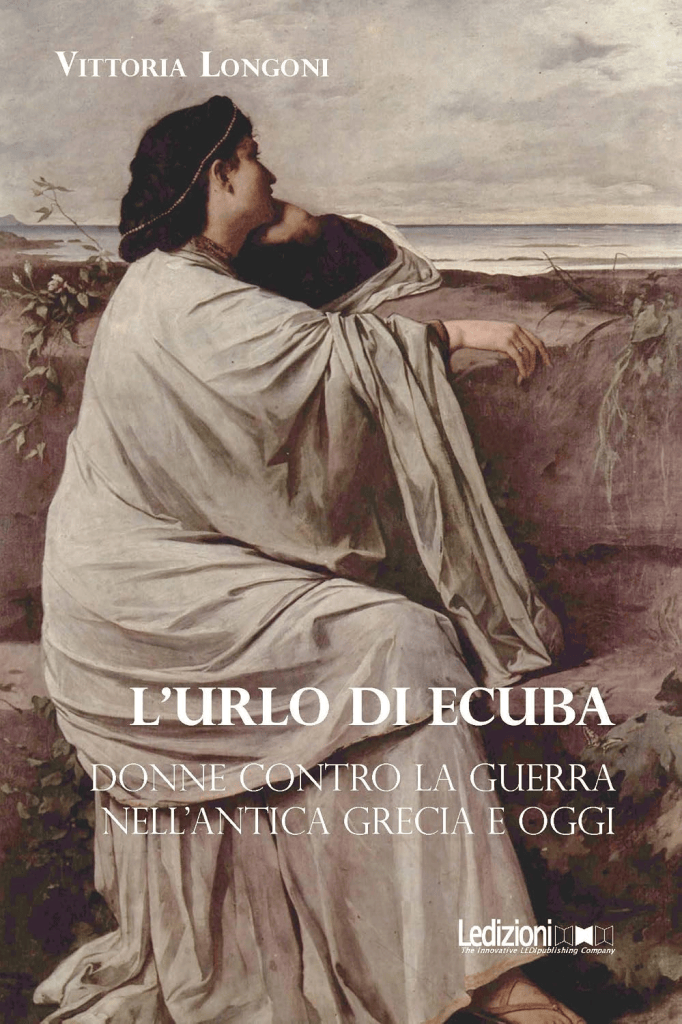
Book review: “L’urlo di Ecuba. Donne contro la guerra nell’antica Grecia e oggi”, by Vittoria Longoni

By Maria Arpaia

The book L’Urlo di Ecuba (Hecuba’s Cry) is a publication designed to reach a wider audience, aimed at establishing a continuity between ancient and modern suffering in the face of the universally shared horror of war.

Starting from the assumption that there is a substantial overlap between the past and the present in terms of the methods and strategies of warfare – starvation, slavery, and human rights abuses are common denominators of all wars – the book examines female figures from mythology in search of a consistent parallel with the contemporary world. The analysis focuses entirely on women, who have always been the primary victims of war: objectified, oppressed, and raped, yet at times also leading figures in movements to raise awareness and speak against injustice.

This book is intended as a tribute to women’s resilience: even in war zones where their role is socially marginalised, women journalists and activists manage to make their voices heard in denouncing injustices and to awaken public conscience.

The structure of the book is repetitive and methodical: each chapter examines a different female figure from ancient mythology (Andromache, Antigone, Hecuba, Iphigenia, Cassandra, Polyxena, etc.), whose story is recounted using literary sources – from epic poetry (the Iliad, the Odyssey and the Epic Cycle) to the tragic and comic theatre of 5th-century BC Athens, with some reference to historians…

Read the full review HERE.

New publication on Primo Levi

Innesti. Primo Levi e i libri altrui, ed. by Gianluca Cinelli and Robert S. C. Gordon, Oxford, Peter Lang, 2020

Primo Levi’s work presents an extraordinarily rich and articulated case of intertextuality. Being a curious, omnivorous, and asystematic reader, Levi explored multiple fields of knowledge – literary, scientific, historical, etc. – browsing between specialized and popular books and magazines, for reasons of research or pure entertainment, often approaching foreign cultures in the original language, driven by his eclectic curiosity and an intense desire to know and understand. Already fathomed in part by Levi himself in his anthology The Search for Roots (1981), his library remains however to be discovered. This volume intends to trace the features of a critical map of the grafts, intertexts and transplants that link Levi’s work to the books of others, by comparing it with twenty-one authors, in a “polyglot and multipurpose” gallery that includes classics such as Dante, Shakespeare, Leopardi, Baudelaire, and Carroll; authors of modern literature such as Kafka, Mann, and Calvino; and scientists such as Galileo, Darwin, Heisenberg, and Lorenz.

Table of contents

Domenico Scarpa: Prefazione xi
Gianluca Cinelli e Robert S. C. Gordon: Introduzione 1

Parte I – Gli strumenti umani
Antonio Di Meo: Primo Levi e William Henry Bragg 19
Mario Porro: Primo Levi e Galileo Galilei 37
Patrizia Piredda: Primo Levi e Werner Heisenberg 55
Alberto Cavaglion: Primo Levi e Giuseppe Gioachino Belli 73
Enzo Ferrara: Primo Levi e Stanislaw Lem 87
Stefano Bartezzaghi: Primo Levi e Lewis Carroll 107


Parte II – La condizione umana
Vittorio Montemaggi: Primo Levi e Dante 127
Valentina Geri: Primo Levi e William Shakespeare 143
Simone Ghelli: Primo Levi e Pierre Bayle 161
Martina Piperno: Primo Levi e Giacomo Leopardi 179
Damiano Benvegnù: Primo Levi e Konrad Lorenz 197
Pierpaolo Antonello: Primo Levi e Charles Darwin 215

Parte III – Comprendere e narrare il Lager
Charles L. Leavitt IV: Primo Levi e Elio Vittorini 237
Uri S. Cohen: Primo Levi e Vercors 255
Sibilla Destefani: Primo Levi e Charles Baudelaire 273
Stefano Bellin: Primo Levi e Franz Kafka 287
Davide Crosara: Primo Levi e Samuel Beckett 305

Parte IV – La ricerca di sé
Martina Mengoni: Primo Levi e Thomas Mann 327
Gianluca Cinelli: Primo Levi e Herman Melville 345
Mattia Cravero: Primo Levi e Ovidio 361
Marco Belpoliti: Primo Levi e Italo Calvino 381

Biografie degli autori 403
Indice dei nomi 407