The Legacy of the Second World War in the Memory of Italian Americans

Memo-AmIt Oral History Project

The Memo-AmIt project, realised by Dr Gianluca Cinelli and Dr Patrizia Piredda as a part of the MemoGen Project with the support of the Ragusa Foundation (New York), is collecting video interviews with Italian Americans born between 1965 and 1985, to understand how the legacy of the conflict has influenced the identity and self-perception of the Italian American community, how it has imprinted the narrative of the war within families and smaller communities, and how it has contributed to reshaping the perception of Italy in post-war America.

Italian American soldiers played a fundamental role in transforming the image of Italians in the United States. In addition, many Italian Americans could reconnect with their ancestral origins by fighting in Italy. Finally, the direct involvement of the second-generation Americans in the Vietnam War influenced the connection between the third generation and the Second World War.

People born approximately between 1965 and 1985 who identify as Italian Americans and want to participate as interviewees can visit the website of the Memo-AmIt project and get in touch with Dr Gianluca Cinelli (giancin77@yahoo.it) for further information.

The corpus of video interviews will constitute a relevant source for understanding Italian-American relations from 1945 to the present day. The interviews will explore themes such as the importance of grandparents’ legacy for personal development and moral education, immigration, integration, multiculturalism, ethical values, the role of education in the development of critical thinking, the damaging effects of propaganda and fake news, the perception of Italy and the legacy of other American wars (Korea, Vietnam, Iraq, and Afghanistan) and the terrorist attacks of September 11, 2001. Finally, the concepts of freedom and democracy as bridges between the past and present are explored.

Today, in the face of the international crisis that the Western world is experiencing, oral history focused on the topicality of the Second World War and its legacy can provide valuable insights to understand and re-evaluate the point of view of Italian Americans, their self-perception and the meaning of Italy in their cultural imagination. Recording video interviews will allow us to investigate a target group that scholars have not considered in previous oral history projects regarding the legacy of the Second World War. Memo-AmIt, therefore, represents an important step in the exploration of the cultural ties between Americans and Italians in relation to one of the major historical events of the twentieth century, which shaped the relations between the two countries and their cultures for decades.

Book Review: “Fascism, the War, and Structures of Feeling in Italy, 1943-1945” by Simonetta Falasca-Zamponi, Oxford, Oxford University Press, 2023

By Gianluca Cinelli

In the wake of recent studies about Italian participation in the Second World War, this volume fills a gap in historical knowledge by focusing on sources that have been neglected or at least not investigated thoroughly and systematically. These sources are diaries that Italian citizens with different social, professional and geographical backgrounds wrote between 25 July 1943 and the end of the war in the spring of 1945. The author analysed 90 diaries (out of 150 consulted) collected at the Archivio della scrittura popolare in Trento, the Archivio diaristico nazionale in Pieve Santo Stefano, and the Archivio Ligure della scrittura popolare in Genoa. The author chose to focus her investigation on diaries because “in a situation characterized by institutional uncertainties and historical unknowns, such as the one Italy faced between 1943 and 1945, feelings of incongruousness and confusion unsettled people’s usual understandings and disrupted their conventional patterns of interpretation and action” (p. 6). Therefore, the day-to-day practice of diary-writing permits her to observe the “ordinary” as it varies across generation, class, and gender and see through these “marginalised narratives” how “people’s interpretation of historical events from the standpoint of their everyday experience affected their responses to those same events and created new political sensibilities” (p. 28). To do that, the author refers to Raymond William’s analytical tool known as “structures of feeling”, a formula cast to convey the idea of the “felt sense of the quality of life” at a particular historical time (p. 4)…

Read the full text here

Call for Articles: Issue n. 8 (2025) – 1945. Close Encounters Between War and Peace

The Close Encounters in War Journal opens the call for submissions for the Issue n. 8 (2025)

Images of exuberant crowds gathering on VE Day and VJ Day from Piccadilly Circus in London to Times Square in New York City have long shaped collective memories of 1945 as the moment when evil totalitarian dictatorships were finally defeated. Thanks to the sacrifices of Allied soldiers and civilians in what has since become known as the “Good War” peace returned and democracy was re-established. It was all a marked difference to how the year had begun.

From the end of January 1945 onwards the discovery of Nazi extermination camps in Europe, most infamously at Auschwitz, exposed the full horror of the Holocaust. The U.S, British, and Soviet forces who liberated the camps found emaciated survivors, mass graves, gas chambers and laboratories for medical experiments on humans. In February, the Allied Strategic Bombing campaign against Germany reached its horrific crescendo when incendiary bombing killed tens of thousands in Dresden. And in eastern and central Europe civilians suffered enormously. It was estimated that on German territory alone some two million women and girls were raped. Many civilians decided to take their own lives to escape what they feared to be a more horrible fate.

Hitler’s suicide on 30th April and the fall of Berlin in early May heralded the German unconditional surrender. But in the Pacific Theatre the fighting continued. During the battle of Okinawa alone (April to June 1945) over 7,600 U.S. troops and some 42,000 civilians were killed in an operation intended to secure a base for what would likely be an even bloodier operation, the invasion of Japan itself. And here, too, Allied bombing exacted a destructive retribution on Imperial Japan: in Tokyo over 84,000 died in March as a consequence of firebombing, which left 16 square miles utterly destroyed. The two atomic bombs dropped on Hiroshima and Nagasaki in August – acts which remain controversial and much debated – likewise caused enormous death and devastation, but they also accelerated Japan’s surrender and the end of the hostilities globally.

Even as the final Allied victory approached, new challenges emerged. In February 1945, at Yalta in Crimea, the ”Big Three” – Roosevelt, Churchill and Stalin – outlined plans for the division of Germany, for the payment of reparations, and for Soviet participation in the war on the Pacific Front. And in July, the Potsdam conference saw the hardening of tensions among and between the Allies so that by 1946 the early outlines of what would become a Cold War between East and West had already started to emerge.

The monumental historiography generated by this conflict has reflected the political and cultural divisions between the belligerents and it has highlighted the troubled and divided memories that exist within participant nations. The earliest comprehensive histories of the Second World War emerged from the field of international relations, and they emphasize the political dimensions of the conflict with a strong focus on strategy and military concerns (e.g., Churchill 1948, Liddell Hart 1970, Calvocoressi and Wint 1972, Taylor 1961). Broader surveys surfaced in the 1980s and 1990s, which looked at themes such as life on the home front and the socio-economic dynamics of total mobilization, including cultural transformations (Keegan 1989, Willmott 1989, Kitchen 1990, Parker 1990, Ellis 1990). Today, scholars tend to integrate local and regional perspectives into overarching narratives (Knapp & Baldoli 2012, Bourque 2019). New sub-disciplines such as diplomatic history and the history of intelligence have helped shed light on some critical aspects such as the Soviet Union’s role in the Axis’ defeat (Beevor 1999, Overy 2012), whereas memory studies and oral history have helped look more closely at people’s experiences (Terkel 1984, Berger Gluck 1987, Summerfield 1998, Dodd 2023).

Issue n. 8 of the CEIWJ aims to investigate the close encounters that occurred in 1945 between war and peace, between civilians and combatants, between the personal and the political, and between past, present, and future. Dr Sam Edwards will join the editorial team as guest editor.

To do so, we invite the submission of articles focused on the investigation of 1945 from a broad spectrum of theoretical and critical perspectives in the fields of Comparative Literature, Cultural History, Ethics, Epistemology, Ethnology, Gender Studies, History of Art, History of Ideas, Linguistics, Memory Studies, Modern Languages, Oral History, Philosophy of Language, Postcolonial Studies, Psychology, Religion, Social Sciences, and Trauma Studies.

We invite, per the scientific purpose of the journal, contributions that focus on human dimensions and perspectives on this topic. The following aspects (among others) may be considered:

  • Diplomatic encounters;
  • Encounters between combatants from different belligerent countries;
  • Encounters between civilians and combatants;
  • Propaganda and ideology (e.g. political perspectives; racism; nationalism; religious fanaticism);
  • Ethical and moral aspects (e.g. personal development; self-understanding; the relation with the others; justification of violence; acceptance of suffering and death);
  • Anti-war attitudes (e.g. pacifism; criticism of violence; desertion and conscience objection; sabotage);
  • Personal narratives and trauma;
  • Decolonisation;
  • Military occupation;
  • Displacement and demobilisation;
  • Identity and diversity (e.g. gender; ethnicity; cultural heritage);

CEIWJ encourages inter/multidisciplinary approaches and dialogue among different scientific fields to promote discussion and scholarly research. The blending of different approaches will be warmly welcomed. Contributions from established scholars, early-career researchers, doctoral students, and practitioners who have dealt with or used personal narratives in the course of their activities will be considered. Case studies that include different geographic areas and non-Western contexts are warmly welcome.

The editors of the Close Encounters in War Journal invite the submission of abstracts of 250 words in English by 31 March 2025 to ceiwj@nutorevelli.org. The authors invited to submit their works will be required to send articles of 8,000-10,000 words (endnotes included, bibliographical references not included in word count), in English by 1 June 2025. All articles will undergo a process of double-blind peer review. We will notify you of the results of the review in September 2025. Final versions of revised articles will be submitted in November 2025. Please see the submission guidelines at: https://closeencountersinwar.org/instruction-for-authors-submissions/.

Download the CfA here

Exhibition in Florence: “Voices of Liberty: Allied Servicemembers of Italian Descent in WWII”

Tuesday April 5, 2022, at 2.30pm – Exhibit hall C.A. Ciampi, Palazzo del Pegaso, via de’ Pucci 16, Florence

Curators Matteo Pretelli and Francesco Fusi

Combatants of Italian descent were present in the various Allied armies that took part in World War II against the Axis Powers. They were mostly sons of emigrants who had left Italy between the late nineteenth and early twentieth centuries. Hundreds of thousands were Italian Americans serving in the U.S. military, but British Italians, Italian Canadians, Italian Australians, and Italian Brazilians also contributed to the war efforts of their countries. Being present in all theatres of the war, they also fought in Italy, a country that many knew only through the stories of their parents. The exhibition reconstructs this fascinating although neglected history by recounting the stories of these men who contributed to the Allied victory.

The exhibition will be open through April 22, 2022, Monday to Friday: 10 am-12 pm and 3-6 pm

Download the flyer here

Issue n. 2 (2019) of CEIWJ is online

Close Encounters, Displacement and War

We are delighted to announce that the second issue of the Close Encounters in War Journal has been published online. This issue marks the real start of our project and is devoted to a topic that seemed relevant to us both for its historical meaning and its topicality. In fact, the issue hosts five contributions by authors who consider the theme of close encounters, displacement and war from a great variety of angles and in different disciplines.

The Issue and single articles can be downloaded here: http://issue-n-2-(2019):-close-encounters,-displacement-and-war

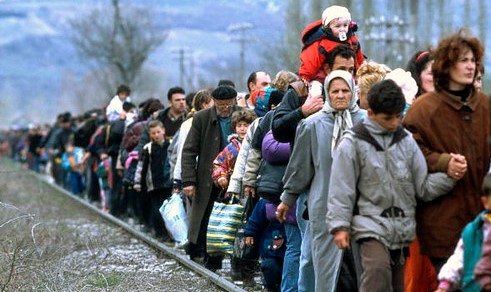
Displacement and forced migration represent some of the most worrying issues of the contemporary world: according to data published by the United Nations Refugee Agency (UNHCR) there are currently 70.8 million forced migrants globally (Figures at a Glance, 2019) and its reports also show that wars, persecutions, violence and human rights violations are among the main causes of current forced migrations. The current crisis is unprecedented and calls for a deep reflection on how to face its urgency, particularly in relation to the situation of the people involved and the humanitarian emergency. In this special issue we look at displacement and forced migration caused by war and conflict in the contemporary era, with a particular focus on the challenges met by those who experienced it.

The five articles collected in the present issue cover a number of case-studies of displacement that vary as to geographical and chronological context, methodological approach, and specific disciplinary field, as far as they range from oral history to cultural history, and cultural studies.

The author of the first contribution, Christoph Declercq, focuses on the “odd case” of Belgian refugees in the United Kingdom during WW1, a small community of displaced people who were warmly welcomed and rather well absorbed in the British daily life, but who were soon after their repatriation forgotten. As Declercq claims, “the destitute Belgians had been used as a tool of warfare and when the war was finally over, those tools were hastily discarded, and all the stories that came with them suppressed” (infra, p. 14), which was one of the reasons why this group of displaced people remained so long forgotten by historians. Actually, as the author shows, the story of this group was more complex than a simple mass movement from Belgium to UK, and the figures of the mobility are therefore analysed thoroughly in order to understand what actual perception the Britons had of this phenomenon of displacement.

In the second article, Simona Tobia presents a number of case-studies deriving from oral history interviews that cover the displacement of Jewish Europeans fleeing from Nazi Germany to the United States before and during WW2, facing very challenging experiences of adaptation and integration. The author opens her article by discussing a number of methodological issues of oral history in order to theoretically frame her work and the use she makes of her sources. Tobia’s main concern is the emotional impact that displacement has on those who experience it, which often affects their ability to remember and share effectively the most traumatic aspects of their journey. She therefore claims that any oral history of displacement must take into account not only the cultural issues related to oral narrative but also the emotional impact of being displaced in terms of identity-building and memory, because “the strategies of memory composure that the narrators in these case studies used revolve around cultural knowledge, on the one hand, and emotions and feelings, on the other” (infra, p. 44).

The author of the third article, Barbara Krasner, touches upon another rather neglected scenario of displacement, namely that of Polish citizens who were caught between Hitler’s and Stalin’s regimes in 1939, when Poland was invaded by the Wehrmacht from the west and by the Red Army from the east. This form of displacement concerned above all the Jewish population of the town of Ostrova, who found themselves trapped between two invaders who equally threatened their survival. Thus, “the decision to cross or not cross the border in the first three months of Nazi and Soviet occupation of Poland had longer-term consequences for the Jews of Ostrova” (infra, p. 63), which reminds us that displacement is a multi-faceted phenomenon that can be very different from case to case. Displacement can turn itself into a deadly condition for those groups of people that for racial, ethnic, religious or political reasons are particularly exposed to persecution both in the place they flee from and in those they try to enter.

The fourth article by Elisheva Perelman takes us in Japan in 1945, when the country is occupied by the American troops and the encounter between the soldiers and the civilians gives birth to the need for normalizing gendered relationships between America and Japan. To cover this topic, Perelman chooses to focus on a well-known post-war product of American pop culture, i.e. the cartoon Babysan, first published in 1951 and depicting the regime of occupation in a palatable way, which means in a sexually hegemonized way. Babysan made thus an ideal ethnographic object through which the Americans could look at defeated and occupied Japan in terms of naivety and objectification. Perleman also shows that the experience of displacement can occur without being removed from one’s own place. Babysan depicts a culture that has been displaced by the very glance that the occupiers have cast on it. As a “symbol of occupation and subjugation, of racism and misogyny” (infra, p. 81), Babysan reveals much about the complex reality of displacement in war.

The fifth and last article considers a more recent scenario, i.e. the worldwide diaspora of Somali citizens in the wake of the Somali civil war. Natoschia Scruggs takes into account testimonies of Somali displaced people resident in the United States, some of whom, though, have had previous experience of displacement in Europe and other countries in Africa or the Middle East. Once again, this article shows that displacement triggers a long chain of identity-related issues in those who are involved, in particular for people coming from cultural milieus where “clan affiliation and one’s immediate family are significant sources of personal identity and security” (infra, p. 92). What emerges is that generalisation is not useful when one attempts to understand the impact of displacement on such aspects as identity-building, self-perception, or social relationships, which are largely dependent on the cultural milieu of origin.We wish to extend a warm thank you to all the people who work with us to realize this project: our Editorial Board, the many scholars who accept to act as peer reviewers, and all those who have supported our project with counsel, criticism and constructive dialogue. And above all, the contributors, who have allowed us the privilege to read and publish their excellent academic work.

Primo Levi’s Hundredth Birthday. 31st July 1919 – 31st July 2019

By Gianluca Cinelli

Primo Levi (Turin, 1919-1987) was a writer known to the world for his works of testimony on deportation to Auschwitz. He was born from a Jewish family and he graduated in chemistry in 1941, despite the restrictions imposed by racial laws to Jewish students. He received from chemistry a first fundamental lesson of life: that in the struggle with matter, humans get a hint of what their own limits and strengths are. Levi realised that imperfection and asymmetry are fundamental aspects of reality, which is not dominated by the Spirit (as the fascist school, marked by distinction between humanistic culture and technical culture, taught)…

Download full article

New open-access book

Lo sguardo lontano. L’Italia della Seconda guerra mondiale nella memoria dei prigionieri di guerra

For those who are interested in Italian history and the memories of prisoners of war (and for those who can read the Italian language), we are pleased to announce the publication of a new open-access book:Lo sguardo lontano. L’Italia della Seconda guerra mondiale nella memoria dei prigionieri di guerra, by Erika Lorenzon (Edizioni Ca’ Foscari Digital Publishing).

The book can be downloaded at http://edizionicafoscari.unive.it/it/edizioni/libri/978-88-6969-268-0/

A Fatal Encounter in War. A Case of Impact of PTSD on Civilians in Christopher Nolan’s “Dunkirk”

by Gianluca Cinelli

Dunkirk (2017) as a war movie seems to direct itself toward a new way of representing war on the screen. No gore, no mangled bodies are to be seen. It seems as though the director meant to say that horror in war does not only depend on the amount of terrifying visions of slaughter, but rather on the psychological perception of fear as an overwhelming emotion that constantly drives the combatant to choose between two basic actions: fighting or fleeing…

Download full article

“Land of Mine”: an Ethical Example of Wisdom and Empathic Rationality

By Patrizia Piredda

The Oresteia by Aeschylus, like every Greek tragic trilogy, represents a series of catastrophes and grieves provoked by the violent feeling of revenge that prevents reason from evaluating the best actions to take. Orestes is hunted and tormented by the Erinyes because he killed his mother, who assassinated her husband, who originally sacrificed their daughter Iphigenia, Orestes’ sister…

Download full article

Encountering Violence and Crimes in Autobiographical Narratives of Operation “Barbarossa”

By Gianluca Cinelli

On 22nd June 1941, the German armies overcame the Russian resistance on the river Bug and started to penetrate in depth in Russia in a drunken state of exaltation. It was the triumph of the Blitzkrieg which many generals considered the only true form of military art, according to the legacy of Clausewitz and Schlieffen: the dimension of the attack was such that the commanders ignored what other units were doing, and the common motto was “forward, no matter what the others do”, in order to annihilate the enemy before this could strike back. For many a soldier this unstoppable advance was just a leap into the void, because after leaving the last villages of the Reich they found themselves alone in the vastness of an unknown land…

Download full article