An unusual close encounter with the enemy

Nuto Revelli’s Il disperso di Marburg after 25 years. Marburg, July 18, 2019

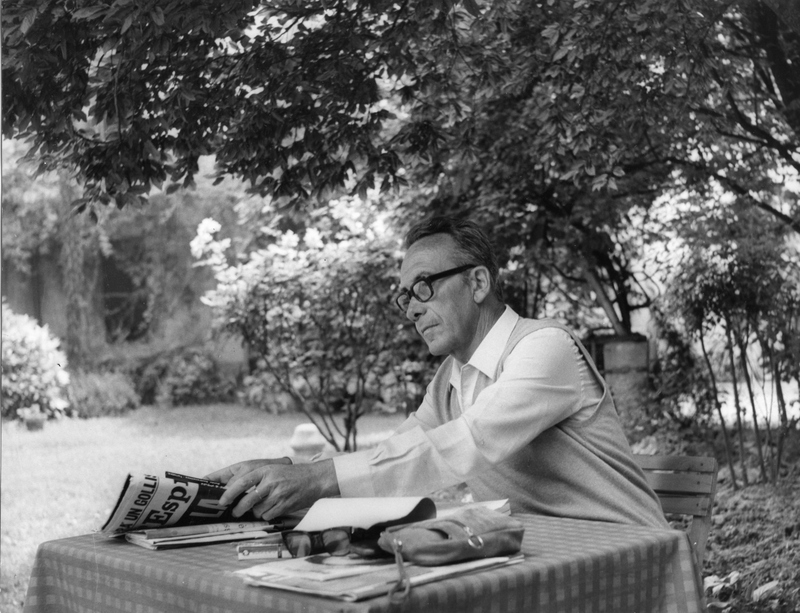
Nuto Revelli.

Nuto Revelli (Cuneo 1919-2004) was an officer of the Italian Royal Army and fought in Russia in 1942-1943. Following the armistice of September 8, 1943 between Italy and the Allies, Revelli joined the anti-fascist partisan groups and fought as commander of the 4th GL Band (later renamed “Carlo Rosselli” Brigade) until the liberation of Italy in April 1945. The experience of war engendered deep hatred against the Germans, which Revelli had met on the Russian front as allies and then as enemies in the mountains of his region (Piedmont). For decades this hatred remained unchanged and the intensity of such feeling was captured in the first books that Revelli published in the post-war period, Mai tardi (1946 and then republished in 1967) and La guerra dei poveri (1962). In these books the Germans are represented as cruel beasts, enemies to hate and despise.

In the 1980s, while collecting oral accounts from peasants in the Alpine valleys of Piedmont, Revelli heard from a former partisan a strange war story, the legend of a German officer who rode off in the countryside and who was kind to the local inhabitants and children, a peaceful and apparently “good” man. One day of 1944 this man disappeared, possibly killed in an ambush of partisans, and since then no one knew anymore about him. This legend disturbed Revelli because it challenged his memories of war and seemed too lenient to be true. Nevertheless, it was the story of a missing-in-action soldier. The memory of soldiers missing in Russia during the retreat from the Don River had tormented Revelli since the end of the war. A missing soldier, the writer said, is the cruellest legacy of any war.

Thus, he decided to engage in the search for the identity of this missing man, and after ten years of work, oral interviews with witnesses and research in German military archives, he succeeded. He discovered that the missing man was a 23-year-old German officer, a student who had not joined the National Socialist Party, who was not enthusiastic about the war and had already lost his older brother in Russia. A young man like so many others, who had been involved into the enormity of the war and had been overwhelmed by a cruel fate.

Fifty years after the war, Revelli thus found the way to reconcile with the hated enemy through a historical quest that in the end also turned out to be an experience of friendship, as far as he befriended the German historian Christoph Schminck-Gustavus, who remained close to Revelli. And, above all, this was a story of reconciliation with the human side of the so-called enemy. The book that tells this story, Il disperso di Marburg, was published in 1994 and for the occasion Revelli visited the German town of Marburg where Rudolf Knaut, the missing officer, was born. This year, on July 18, Marburg hosted an event dedicated to Revelli and to Il disperso di Marburg to celebrate the centenary of the writer’s birth (July 21). Gianluca Cinelli gave two lectures at the Institut für romanische Philologie at Philipps-Universität Marburg and at the Technologie- und Tagungszentrum in the presence of a large audience.

Announcement: Research project “Upgrading history”

The Research project Upgrading History. Diaries from the War Front by Dr Saverio Vita is about to be presented officially at the University of Bologna

Photo credits: https://www.europeana.eu/portal/it/record/2020601/contributions_17136_attachments_179895

Upgrading History. Diaries from the War Front is one of the three new projects funded by Europeana Foundation in 2018. The project is hold by Saverio Vita, fellow researcher at the University of Bologna, and hosted by DH.ARC (Digital Humanities Advanced Center).

The aim of the project is to share research that focuses on the diaries of European soldiers who fought the First World War with a larger audience. Europeana Collections includes a good amount of soldiers’ writings (especially in Italian, French and English) and paintings, as well as a collection of letters from the trenches by Isaac Rosenberg. By now, Rosenberg’s letters and eight diaries in Italian and French were processed.

The materials are arranged on the StoryMaps platform, highlighting the different itineraries travelled by a single soldier. Each journey track is enriched by the text itself and other media, such as photographs, selected newspaper pages, and videos from the Collections. Having the chance to follow the soldier’s itinerary is the best way to read a war diary. This project aims to preserve historical memory and to reactivate old personal stories, to renew them.

For the skilled user who wants to deepen knowledge of the diaries and to read a technical analysis of the text, the project offers digital editions based on EVT, with full transcriptions, historical and linguistic comments.

The project represents a sort of pilot, open to further updates. The Map becomes the promotional container of other research on similar topics, from FICLIT and other departments in Italy and other countries. The goal is to create a great open map, available to the largest possible number of users, detailing one of the most important periods in European History. The dissemination of this kind of project is especially valuable today, as Europe and its Institutions are living in a critical time. A project about WWI is a project about our shared past and History.

Announcement: Experiencing War at the Library of Congress

For the 75th anniversary of D-Day, the Library of Congress published a webpage titled Experiencing War. Researchers and anyone who is interested can access 12 collections with diaries, photos and oral histories of men and women who experienced that event.

The page can be accessed at this link: https://www.loc.gov/vets/stories/ex-war-dday75.html

The materials are part of one of the Library of Congress’ special projects: the Veterans History Project (VHP), part of the American Folklife Center, which collects personal accounts of American war veterans with the aim to preserve the memories of war and conflicts in which the United States took part, from the First World War up to the wars in Iraq and Afghanistan. The VHP’s materials provide a wealth of sources for researchers who work on experiences of war, and many of those can be accessed remotely through their website: https://www.loc.gov/vets/

Announcement: Shadow Agents of War Workshop

A fascinating event is taking place next week on 4th June at the University of Edinburgh: a one day workshop titled “Shadow Agents of War”, which will focus on the role in war of certain players who are largely overlooked by scholars of war and conflict, such as refugees, convicts, commoners and even animals. The workshop also promises to tackle methodological issues and point to relevant sources. The workshop is co-organised by Stephen Bowd, who is currently working on a project on gender and early modern warfare, Sarah Cockram, who focuses on the early modern period, too, and is interested in historical animal studies, and John Gagné whose current book project is on transcultural war in the early sixteenth century.

The workshop will have three sessions: The Unwilling Agents of War; The Organisers of War; The Suppliers of War.

The full programme can be accessed by following this link: https://research.shca.ed.ac.uk/shadow-agents-of-war/

New article: “Das Bild des italienischen Soldaten im deutschsprachigen Diskurs über die Vergangenheitsverwaltung”

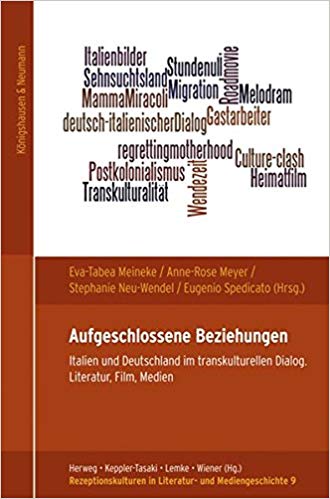
Das Bild des italienischen Soldaten im deutschsprachigen Diskurs über die Vergangenheitsverwaltung, in Aufgeschlossene Beziehungen. Deutschland und Italien im transkulturellen Dialog. Literatur, Film, Medien, ed. by Tabea Meineke, Anne-Rose Meyer-Eisenhut, Stephanie Neu-Wendel and Eugenio Spedicato, Würzburg, Verlag Königshausen & Neumann, 2019, 67-80

Among the contributions appeared in the book Aufgeschlossene Beziehungen (Open-minded Relationships), devoted to the exploration of the way in which the Italian and German cultures have built their transcultural dialogue since WW2, one chapter by Gianluca Cinelli investigates how German post-war narratives, both literary and historical, represented the Italian soldiers in a very negative way, thus paving the way to the consolidation of an old anti-Italian prejudice spread all over Germany. The German combatants came across the Italians during WW2 as allies between 1940 and September 8, 1943, when Italy surrendered to the Allies. What emerges from this contribution is that little attention has been paid in Germany to this topic. Nonetheless, Italian soldiers were represented as lazy and unfit for war, unworthy in battle and unreliable as allies, cowardly and too soft to endure the hardship of modern warfare. And even worse, they were depicted as traitors following Italy’s withdrawal from the conflict in 1943, after which a remarkable number of Italians began to fight against the Germans as partisans.

The chapter builds on historical and literary sources, by combining the testimonies of former German cambatants (from privates of the Afrikakorp to memoirs of such Whermacht higher officers as Rommel or Kesselring) with historic evidence collected by mainly German scholars (from Hammerman to Klinkhammer and Schlemmer). The main thesis of the chapter consists in claiming that the anti-Italian prejudice largely depended on the effectiveness of Nazi propaganda and on the circulation of a number of testimonies that depicted the Italians as inferiors not only as for their military virtues but also on a racial basis. In the end, only the massive integration of Italian immigrants starting from the 1950s began to challenge the dominant stereotype and to rehabilitate the memory of the former allies-and-enemies as human beings and fellow citizens.

Conference announcement: “Giellismo e Azionismo. Cantieri aperti”

15th edition, Turin, Istoreto, 17-18 May 2019

The Istituto Piemontese per la Storia della Resistenza e della Società Contemporanea “Giorgio Agosti” will host the 15th edition of the research seminar “Giellismo e azionismo – cantieri aperti” on the 17th and 18th of May 2019.

The complete program of the seminar can be downloaded at:

http://www.istoreto.it/ricerca/giellismo-e-azionismo-cantieri-aperti/#

New open-access book

Lo sguardo lontano. L’Italia della Seconda guerra mondiale nella memoria dei prigionieri di guerra

For those who are interested in Italian history and the memories of prisoners of war (and for those who can read the Italian language), we are pleased to announce the publication of a new open-access book:Lo sguardo lontano. L’Italia della Seconda guerra mondiale nella memoria dei prigionieri di guerra, by Erika Lorenzon (Edizioni Ca’ Foscari Digital Publishing).

The book can be downloaded at http://edizionicafoscari.unive.it/it/edizioni/libri/978-88-6969-268-0/

Issue n. 1 of the Close Encounters in War Journal is online

Issue n. 1: “Close Encounters in Irregular and Asymmetric War” (2018)

We are delighted to announce that the first issue of the Close Encounters in War Journal has been published online. This issue marks the real start of our project and is devoted to a topic that seemed relevant to us both for its historical meaning and its topicality. In fact, the issue hosts five contributions by authors who consider the theme of close encounters in irregular and asymmetric war from a great variety of angles and in different disciplines.

The Issue and individual articles can be downloaded at:

Issue n. 1 (2018): Close encounters in irregular and asymmetric war

ceiw-logo-wordcloud prova 1

What today is referred to as “irregular warfare” is one of the most ancient types of conflict, as opposed to “conventional warfare”, which is a relatively more recent development. The combat strategies and tactics used by tribal warriors, modern guerrillas, resistance fighters and terrorists have been attracting the attention of military historians, strategists and intelligence experts, focusing on resistance, insurgency, counter-insurgency and more recently terrorism. Beside its practical efficacy on the battlefield, irregular war has always stirred popular imagination. But how do human beings experience this particular type of warfare? Does it seem more threatening and scary because it can involve civilians more deeply? Does it blur the traditional idea of war as open confrontation with a recognisable enemy?

The multidisciplinary collection of articles presented in this issue invites a reflection on irregular and asymmetric warfare that goes beyond military strategy and tactical effectiveness, and aims to examine this subject through the lens of “close encounters” in order to explore its impact on human experience. In this perspective, a few recurring elements emerge in all the seven articles: irregular warfare involves an unequal fight between unequal enemies. There is no balance of power and this asymmetry between adversaries means that lines get blurred, for example between combatants and non combatants, or between regular and irregular forces. Irregular and asymmetric warfare blurs the lines and rules of conflict, but it also resurfaces the agency of those who are invisible in war.
The first three articles in the collection are more factual and they explore the blurred identities and often divided loyalties of those involved in irregular conflicts. According to their authors, those who fight “from below”, often the less powerful, find agency.

Brad St. Croix explores asymmetric warfare within the context of a wide conflict, focusing on the Pacific theatre of the Second World War. In Hong Kong, the British had to fight an irregular force as they faced a Japanese-inspired fifth column. The author sees this as having a deeply destabilizing power for the British, even if blurring the lines between regular and irregular forces was a tactic often used by the Japanese. However, the interesting point that emerges from this analysis is that blurred lines and changing loyalties in this context were due to the multiethnic makeup of the colony. In the Battle of Hong Kong invisibility was key for the fifth columnists, who used hiding and disguise as well as tactics such as sniping to conceal their identities and destabilize the enemy. Their invisibility still represents a challenge for historians who want determine their numbers and identity.

María Gómez-Amich offers a study based on interviews with five former conflict zone interpreters who were locally recruited by the Spanish troops deployed in Afghanistan between 2003 and 2014 as part of the NATO ISAF mission. By looking at the narratives of these interviewees in the effort to analyse their agency, his study emphasizes many lines getting blurred, such as the line between east and west, foreign and local, military and civilian, but also those, perhaps less obvious, between trust and mistrust, loyalty and neutrality, which are the key ones for professional interpreters. In this context, locally recruited interpreters are given the role of gatekeepers thanks to their cultural capital and they experience blurred loyalties because they are often seen as traitors by their own group and as outsiders by their employers. Another important point in this analysis is that irregular warfare blurs the fundamental ethical principles of interpreting, as it accentuates the tension between neutrality and agency.

In his article Gian Marco Longoni looks at another contemporary example of irregular warfare: the Houthi insurgency begun in 2004 that ousted the Yemeni government in 2015. In his effort to examine the three reasons for the outcome of this insurgency, Longoni emphasizes once again the asymmetry of the conflict and the agency of the insurgents. They find agency through the use of violence and capitalize on the weakness of the Yemeni regime. But there are also other, more cultural reasons that can explain the outcome of the revolt: the Zaydi insurgents experienced a shared identity and shared narratives which can be dubbed as their cultural identity, which were keys in the context of this conflict. It seems that when cultural identity is not conflictual in itself, but clearly defined as in this instance, loyalty does not represent an issue. Asymmetry has a double impact here because while it is true that the fight is between unequal enemies, it is the insurgents who find strength in their cultural identity, whereas the regular forces are weak, dysfunctional and incapable of adequate counterinsurgency despite being the representatives of the institutions.

The second set of articles is more focused on meaning and representation. The concept of irregular and asymmetric warfare is interpreted in different ways, but both articles agree on one point: asymmetric conflict has the power to transform the individual, affecting the spheres of imagination, self-perception, and cultural reception. What these articles suggest is that asymmetric war almost always implies disequilibrium of forces and a polarisation of conflict as a struggle between “stronger” and “weaker” opponents, in particular women and children. By no accident, in fact, these articles explore the issue of close encounters in asymmetric war from the standpoint of its cultural interpretation and representation.

In her analysis of the rape scene in Elsa Morante’s novel La storia, Stefania Porcelli talks about a literary encounter with war. The author interprets the concept of asymmetry as lack of balance between the adversaries, who are fragile actors who never win against stronger enemies. In this analysis the lines between victim and oppressor, innocence and evil, become blurred, as the author stresses how Morante insists on the concept of power, and of how the powerful (represented by Gunther, stronger but doomed to succumb to history), become themselves victims. Fear, sometimes terror, is at the core of this particular asymmetric conflict, in which the victim is stripped of agency because rape “is an act of violence against a woman wholly bereft of agency” (Porcelli, p. 89). But here it also represents the loss of innocence that bears a transformative power.

Benjamin Nickl sees asymmetric conflict through the eyes of child warriors in popular fiction. In his analysis of the representation of children in arms Nickl wonders whether they are a way to represent and give meaning to the trauma of war. Child characters invite a shift in the point of view on war, which can lead to a more genuine approach, as “audiences seem willing to suspend their disbelief readily” (Nickl, p. 104) when the narrator is a child. Nickl interprets the concept of irregular and asymmetric warfare very widely, including fictional conflicts against terrible monsters or evil warlords, but what these all have in common is that they all involve a shift in the point of view and the transformational loss of innocence as consequences of the trauma caused by war.

The selected articles range over a number of wars, different from one another in time, space, scale, and context; and their authors consider the topic of “close encounters in irregular and asymmetric war” from the standpoints of different disciplines and methodological approaches, among which, for example, cultural and military history, literary studies, gender studies, oral history, translation studies, and postcolonial studies. This variety reflects the multidisciplinary project of Close Encounters in War journal and will hopefully fuel further interest in the cultural and collateral aspects of war as a fundamental aspect of human evolution and cultural specificity. Irregular and asymmetric warfare blurs the lines and rules of conflict, but it also resurfaces the agency of those who are invisible in war.
A Fatal Encounter in War. A Case of Impact of PTSD on Civilians in Christopher Nolan’s “Dunkirk”

by Gianluca Cinelli

Dunkirk (2017) as a war movie seems to direct itself toward a new way of representing war on the screen. No gore, no mangled bodies are to be seen. It seems as though the director meant to say that horror in war does not only depend on the amount of terrifying visions of slaughter, but rather on the psychological perception of fear as an overwhelming emotion that constantly drives the combatant to choose between two basic actions: fighting or fleeing…

Download full article

“Land of Mine”: an Ethical Example of Wisdom and Empathic Rationality

By Patrizia Piredda

The Oresteia by Aeschylus, like every Greek tragic trilogy, represents a series of catastrophes and grieves provoked by the violent feeling of revenge that prevents reason from evaluating the best actions to take. Orestes is hunted and tormented by the Erinyes because he killed his mother, who assassinated her husband, who originally sacrificed their daughter Iphigenia, Orestes’ sister…

Download full article