Book Review: “Fascism, the War, and Structures of Feeling in Italy, 1943-1945” by Simonetta Falasca-Zamponi, Oxford, Oxford University Press, 2023

By Gianluca Cinelli

In the wake of recent studies about Italian participation in the Second World War, this volume fills a gap in historical knowledge by focusing on sources that have been neglected or at least not investigated thoroughly and systematically. These sources are diaries that Italian citizens with different social, professional and geographical backgrounds wrote between 25 July 1943 and the end of the war in the spring of 1945. The author analysed 90 diaries (out of 150 consulted) collected at the Archivio della scrittura popolare in Trento, the Archivio diaristico nazionale in Pieve Santo Stefano, and the Archivio Ligure della scrittura popolare in Genoa. The author chose to focus her investigation on diaries because “in a situation characterized by institutional uncertainties and historical unknowns, such as the one Italy faced between 1943 and 1945, feelings of incongruousness and confusion unsettled people’s usual understandings and disrupted their conventional patterns of interpretation and action” (p. 6). Therefore, the day-to-day practice of diary-writing permits her to observe the “ordinary” as it varies across generation, class, and gender and see through these “marginalised narratives” how “people’s interpretation of historical events from the standpoint of their everyday experience affected their responses to those same events and created new political sensibilities” (p. 28). To do that, the author refers to Raymond William’s analytical tool known as “structures of feeling”, a formula cast to convey the idea of the “felt sense of the quality of life” at a particular historical time (p. 4)…

Read the full text here

War Diary: The Diary of Mike Rogers

By Alan Beardsley

“War Diary: The Diary of Mike Rogers” is a compelling personal narrative that offers an intimate glimpse into the life and experiences of Michael John Warrington Rogers during World War II. Spanning from the outbreak of WW2 in 1939, to the end of 1945 and the dropping of the atomic bombs, War Diary: The Diary of Mike Rogers entries chronicle the daily realities of war, from the grand strategic movements of the Allied forces to the personal struggles and moments of respite that defined his existence.

Through Mike Rogers’ eyes, readers are transported to the front lines of pivotal events such as the Dunkirk Evacuations, The Blitz and later in the War, the Battle of Normandy, the liberation of Paris, and the harrowing Battle of the Bulge. His reflections on the relentless V2 bombings and the bold, albeit ultimately unsuccessful, German Operations provide a vivid account of the war’s impact on civilians.

The accompanying website, www.wardiaryonline.com, serves as a digital archive and interactive platform where readers can explore additional content, including photographs, historical documents, and detailed maps. The website also invites contributions from those with connections to the events described, enriching the narrative with personal stories and memorabilia.

“War Diary: The Diary of Mike Rogers” is more than just a historical document; it is a testament to the resilience and determination of individuals facing extraordinary circumstances. Through Mike Rogers’ detailed and poignant entries, “War Diary: The Diary of Mike Rogers” offers a powerful and personal perspective on World War II, making it an essential addition to the study of personal narratives in wartime history.

“War Diary: The Diary of Mike Rogers” stands out for its raw, unfiltered portrayal of wartime life. The War Diary: The Diary of Mike Rogers project not only preserves the legacy of those who lived through these tumultuous times but also provides invaluable insights into the human condition under the pressures of war.

Call for Articles for Issue n. 7 (2024): Close Encounters in War and Personal Narratives. Experience, Memory, and Storytelling

As a genre, personal narratives have evolved over two centuries, passing from being almost exclusively memoirs written by high-ranking officers (mostly noble) to consisting of a much more multifaceted variety of expressive forms including letters, diaries, autobiographical sketches, poems, published or unpublished memoirs, oral histories and autobiographical fiction. After a long-lasting prejudice that banned personal narratives from the history of war and conflict, which was relegated to the disciplinary field of Military History, since the 1960s historians have begun to look at these narrations as valid and valuable sources of historical knowledge, thus giving impulse, after the so-called “cultural” and “narrative” turns after the 1970s, to the birth of sub-disciplines such as Micro-History, History of Mentality, Cultural History, Oral History and more recently the History of the Emotions. Working with personal narratives is a challenging scholarly enterprise due to the flickering and multifaceted nature of this kind of written expression, which is transversal to literary genres while including forms, styles, and registers typical of the spoken language. Personal narratives can hardly provide an overall comprehension and depiction of war, as they can inform about events that occurred on a smaller scale and the perception that human beings have of the war as a direct experience. Therefore, working with personal narratives often requires intellectual flexibility and the ability to blend different disciplinary approaches by borrowing diverse methodological, critical and analytical tools.

Issue n. 7 of the CEIWJ aims to investigate the theme of the close encounters in war in connection with the universe of personal narratives to study how people have accounted for their personal experience of war in ancient, pre-modern, modern and contemporary periods. Guest Editor for Issue n. 7: Fabio Caffarena (University of Genoa).

The editors of the Close Encounters in War Journal invite the submission of abstracts of 250 words in English by 31 March 2024 to ceiwj@nutorevelli.org.

Download the CfA here

A New Website is Online: Nazi Massacres in Occupied Italy (1943-1945). The Perpetrators and their Memory

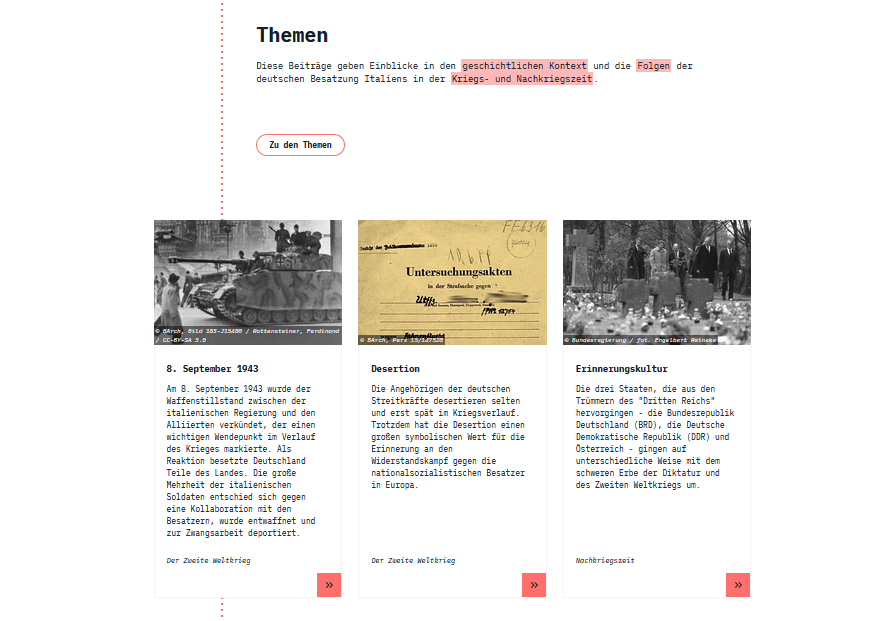
Up to 70,000 Italians fell victim to the German occupation of Italy in the Second World War. More than 10,000 were killed by German troops in massacres and mass executions. Starting on 4 May 2023, texts, photos, biographies of perpetrators, reconstructions of massacres, case studies, and videos on this dark chapter in the history of Germany and Italy will be available at www.ns-taeter-italien.org.

The website was developed in the framework of a project about German massacres in Italy during the Second World War (NS-Täter. Le stragi naziste nell’Italia occupata, 1943-1945 / NS-Täter. Die Massaker im besetzten Italien in der Erinnerung der Täter, 1943-1945), and designed in cooperation with the Berlin-based Lime Flavour agency. From its inception in August 2019, the project has been supported by the German Federal Foreign Office in the framework of the German-Italian Future Fund. Based at the Martin Buber Institute of Jewish Studies (University of Cologne), the project is directed by historian Carlo Gentile in collaboration with journalist Udo Gümpel, and the participation of the Fondazione Scuola di Pace di Monte Sole, and the theatre company Archivio Zeta. At present, the website is accessible in Italian and German but an English version will be soon available for the benefit of the broader public worldwide.

The project addresses different audiences including the general public, educational institutions, memorial sites, and museums. The perpetrators stand at the centre of the historical inquiry: What mentality and psychological dispositions imprinted their actions? What were their social-biographical backgrounds? What room for decision and action was at their disposal? What patterns of legitimation can be identified in their narratives?

The website hosts well-documented historical reconstructions of the Nazi massacres in Italy between 1943 and 1945, based on documentation extracted from forty archives in Germany, Italy, Austria, Great Britain, Russia, and the United States. Such materials include ego-documents, records from the wartime and post-war periods, video recordings, and photos. The digitalisation of the sources is in progress. However, a part of the collection is already available online from the research database Invenio of the German Bundesarchiv. The website is divided into 5 sections:

  1. The massacres: this section presents the stories of the massacres, each of which includes an interactive map, and a synthetic file about the judicial investigations and the people involved. Individual biographies of perpetrators as well as information about Wehrmacht and SS units are provided here along with case studies and the historical reconstruction of the massacres;
  2. The perpetrators: this section provides a list of the Nazi perpetrators with their bios, synthetic personal record, historical info, and pictures;
  3. The themes: this section embeds 4 further subsections: the trials for the Monte Sole massacres; memory; German deserters; and the memory of September 8, 1943 from the perspective of the Nazi perpetrators;
  4. The sources: this section includes military and judicial documents, ego-documents, and pictures;
  5. Educational projects: this section lists the activities aimed at handing down the memory of the historical past among the broader public.

Close Encounters in War launches a new section for stories and poetry

Stories and poems of close encounters in war

Close encounters in war are, before anything else, life experiences that change in depth those who make them. As editors of the Close Encounters in War Journal, we have always been aware of this simple but basic fact and therefore decided to open the third issue of the journal (2020) to creative writing. We wanted to propose an experimental encounter between scholarly research and forms of creative and non-fictional writing whose roots go deep into experience and imagination.

After that exciting experience, being aware that stories and poems of close encounters in war deserve a place of their own in the website, we are happy to announce the launch of the new section “Stories and poems of close encounters in war“.

This new section of the journal is divided into three subsections (Poetry, Fiction, and Testimonies and Autobiographical Essays) and is meant to be a space for creativity and exploration of all those forms of writing that help us understand war more thoroughly as a multifaceted and complex experience. We invite storytellers, veterans, practitioners, relatives and friends of veterans, poets, therapists, and much more to feel free to submit their contributions to the CEIWJ. We will be happy and grateful to read year round your original and unpublished works about your encounters in and with war, real and imagined. We will select and publish the best, more insightful, and inspiring contributions.

Announcement: Research project “Upgrading history”

The Research project Upgrading History. Diaries from the War Front by Dr Saverio Vita is about to be presented officially at the University of Bologna

Photo credits: https://www.europeana.eu/portal/it/record/2020601/contributions_17136_attachments_179895

Upgrading History. Diaries from the War Front is one of the three new projects funded by Europeana Foundation in 2018. The project is hold by Saverio Vita, fellow researcher at the University of Bologna, and hosted by DH.ARC (Digital Humanities Advanced Center).

The aim of the project is to share research that focuses on the diaries of European soldiers who fought the First World War with a larger audience. Europeana Collections includes a good amount of soldiers’ writings (especially in Italian, French and English) and paintings, as well as a collection of letters from the trenches by Isaac Rosenberg. By now, Rosenberg’s letters and eight diaries in Italian and French were processed.

The materials are arranged on the StoryMaps platform, highlighting the different itineraries travelled by a single soldier. Each journey track is enriched by the text itself and other media, such as photographs, selected newspaper pages, and videos from the Collections. Having the chance to follow the soldier’s itinerary is the best way to read a war diary. This project aims to preserve historical memory and to reactivate old personal stories, to renew them.

For the skilled user who wants to deepen knowledge of the diaries and to read a technical analysis of the text, the project offers digital editions based on EVT, with full transcriptions, historical and linguistic comments.

The project represents a sort of pilot, open to further updates. The Map becomes the promotional container of other research on similar topics, from FICLIT and other departments in Italy and other countries. The goal is to create a great open map, available to the largest possible number of users, detailing one of the most important periods in European History. The dissemination of this kind of project is especially valuable today, as Europe and its Institutions are living in a critical time. A project about WWI is a project about our shared past and History.

Issue n. 1 of the Close Encounters in War Journal is online

Issue n. 1: “Close Encounters in Irregular and Asymmetric War” (2018)

We are delighted to announce that the first issue of the Close Encounters in War Journal has been published online. This issue marks the real start of our project and is devoted to a topic that seemed relevant to us both for its historical meaning and its topicality. In fact, the issue hosts five contributions by authors who consider the theme of close encounters in irregular and asymmetric war from a great variety of angles and in different disciplines.

The Issue and individual articles can be downloaded at:

Issue n. 1 (2018): Close encounters in irregular and asymmetric war

ceiw-logo-wordcloud prova 1

What today is referred to as “irregular warfare” is one of the most ancient types of conflict, as opposed to “conventional warfare”, which is a relatively more recent development. The combat strategies and tactics used by tribal warriors, modern guerrillas, resistance fighters and terrorists have been attracting the attention of military historians, strategists and intelligence experts, focusing on resistance, insurgency, counter-insurgency and more recently terrorism. Beside its practical efficacy on the battlefield, irregular war has always stirred popular imagination. But how do human beings experience this particular type of warfare? Does it seem more threatening and scary because it can involve civilians more deeply? Does it blur the traditional idea of war as open confrontation with a recognisable enemy?

The multidisciplinary collection of articles presented in this issue invites a reflection on irregular and asymmetric warfare that goes beyond military strategy and tactical effectiveness, and aims to examine this subject through the lens of “close encounters” in order to explore its impact on human experience. In this perspective, a few recurring elements emerge in all the seven articles: irregular warfare involves an unequal fight between unequal enemies. There is no balance of power and this asymmetry between adversaries means that lines get blurred, for example between combatants and non combatants, or between regular and irregular forces. Irregular and asymmetric warfare blurs the lines and rules of conflict, but it also resurfaces the agency of those who are invisible in war.

The first three articles in the collection are more factual and they explore the blurred identities and often divided loyalties of those involved in irregular conflicts. According to their authors, those who fight “from below”, often the less powerful, find agency.

Brad St. Croix explores asymmetric warfare within the context of a wide conflict, focusing on the Pacific theatre of the Second World War. In Hong Kong, the British had to fight an irregular force as they faced a Japanese-inspired fifth column. The author sees this as having a deeply destabilizing power for the British, even if blurring the lines between regular and irregular forces was a tactic often used by the Japanese. However, the interesting point that emerges from this analysis is that blurred lines and changing loyalties in this context were due to the multiethnic makeup of the colony. In the Battle of Hong Kong invisibility was key for the fifth columnists, who used hiding and disguise as well as tactics such as sniping to conceal their identities and destabilize the enemy. Their invisibility still represents a challenge for historians who want determine their numbers and identity.

María Gómez-Amich offers a study based on interviews with five former conflict zone interpreters who were locally recruited by the Spanish troops deployed in Afghanistan between 2003 and 2014 as part of the NATO ISAF mission. By looking at the narratives of these interviewees in the effort to analyse their agency, his study emphasizes many lines getting blurred, such as the line between east and west, foreign and local, military and civilian, but also those, perhaps less obvious, between trust and mistrust, loyalty and neutrality, which are the key ones for professional interpreters. In this context, locally recruited interpreters are given the role of gatekeepers thanks to their cultural capital and they experience blurred loyalties because they are often seen as traitors by their own group and as outsiders by their employers. Another important point in this analysis is that irregular warfare blurs the fundamental ethical principles of interpreting, as it accentuates the tension between neutrality and agency.

In his article Gian Marco Longoni looks at another contemporary example of irregular warfare: the Houthi insurgency begun in 2004 that ousted the Yemeni government in 2015. In his effort to examine the three reasons for the outcome of this insurgency, Longoni emphasizes once again the asymmetry of the conflict and the agency of the insurgents. They find agency through the use of violence and capitalize on the weakness of the Yemeni regime. But there are also other, more cultural reasons that can explain the outcome of the revolt: the Zaydi insurgents experienced a shared identity and shared narratives which can be dubbed as their cultural identity, which were keys in the context of this conflict. It seems that when cultural identity is not conflictual in itself, but clearly defined as in this instance, loyalty does not represent an issue. Asymmetry has a double impact here because while it is true that the fight is between unequal enemies, it is the insurgents who find strength in their cultural identity, whereas the regular forces are weak, dysfunctional and incapable of adequate counterinsurgency despite being the representatives of the institutions.

The second set of articles is more focused on meaning and representation. The concept of irregular and asymmetric warfare is interpreted in different ways, but both articles agree on one point: asymmetric conflict has the power to transform the individual, affecting the spheres of imagination, self-perception, and cultural reception. What these articles suggest is that asymmetric war almost always implies disequilibrium of forces and a polarisation of conflict as a struggle between “stronger” and “weaker” opponents, in particular women and children. By no accident, in fact, these articles explore the issue of close encounters in asymmetric war from the standpoint of its cultural interpretation and representation.

In her analysis of the rape scene in Elsa Morante’s novel La storia, Stefania Porcelli talks about a literary encounter with war. The author interprets the concept of asymmetry as lack of balance between the adversaries, who are fragile actors who never win against stronger enemies. In this analysis the lines between victim and oppressor, innocence and evil, become blurred, as the author stresses how Morante insists on the concept of power, and of how the powerful (represented by Gunther, stronger but doomed to succumb to history), become themselves victims. Fear, sometimes terror, is at the core of this particular asymmetric conflict, in which the victim is stripped of agency because rape “is an act of violence against a woman wholly bereft of agency” (Porcelli, p. 89). But here it also represents the loss of innocence that bears a transformative power.

Benjamin Nickl sees asymmetric conflict through the eyes of child warriors in popular fiction. In his analysis of the representation of children in arms Nickl wonders whether they are a way to represent and give meaning to the trauma of war. Child characters invite a shift in the point of view on war, which can lead to a more genuine approach, as “audiences seem willing to suspend their disbelief readily” (Nickl, p. 104) when the narrator is a child. Nickl interprets the concept of irregular and asymmetric warfare very widely, including fictional conflicts against terrible monsters or evil warlords, but what these all have in common is that they all involve a shift in the point of view and the transformational loss of innocence as consequences of the trauma caused by war.

The selected articles range over a number of wars, different from one another in time, space, scale, and context; and their authors consider the topic of “close encounters in irregular and asymmetric war” from the standpoints of different disciplines and methodological approaches, among which, for example, cultural and military history, literary studies, gender studies, oral history, translation studies, and postcolonial studies. This variety reflects the multidisciplinary project of Close Encounters in War journal and will hopefully fuel further interest in the cultural and collateral aspects of war as a fundamental aspect of human evolution and cultural specificity. Irregular and asymmetric warfare blurs the lines and rules of conflict, but it also resurfaces the agency of those who are invisible in war.

War as Moral Experience in Wittgenstein’s Secret Diary

by Patrizia Piredda

When he stopped his studies of engineering in Manchester, Wittgenstein moved to Cambridge to study logic under the guidance of Bertrand Russell because he believed that by comprehending the fundamentals of language, and therefore the limits of language, he would understand its essence,   as well as that of human beings, in primis, himself…

Download full article

Encountering war in the letters from the front

By Gianluca Cinelli

The letters sent from the front during WWII constitute a broad universe which we are just partially familiar with (tens of thousands of letters out of billions). Only a very small portion of the immense corpus of letters from and to the fronts has been published, which means that such a form of testimony constitutes an important but also distorted means of encounter with war. Do therefore letters constitute a good means for encountering war? Do people at home really come across war, when they read the letters received from their loved ones at the front?…

Download full article